10 Key Factors That Extend Mold Life
Proper steel selection, suitable hardening, regular maintenance, and process control can significantly extend mold life.
6/29/20266 min read
10 Key Factors That Extend Mold Life
Meta Title: 10 Key Factors That Extend Mold Life | Gri Kalıp
Meta Description: In plastic injection molds, proper steel selection, regular maintenance, process control, and suitable operating conditions can significantly extend mold life.
URL Slug: 10-key-factors-that-extend-mold-life
Blog Card Short Description: Proper steel selection, suitable hardening, regular maintenance, and process control can significantly extend the life of plastic injection molds. In this article, we examine 10 key factors that help extend mold life.
Why Is Mold Life Important in Plastic Injection Molds?
Plastic injection molds are among the most valuable equipment in mass production. A mold is not simply a metal structure that forms the product shape; it is a strategic production tool that directly affects production quality, cycle time, dimensional stability, and total cost.
Mold life refers to how many shots a mold can produce while maintaining stable and high-quality production. A mold that is well designed, manufactured from the right steel, maintained regularly, and used under correct process conditions can operate reliably for many years. On the other hand, incorrect steel selection, insufficient maintenance, incorrect process settings, or poor operating conditions can significantly shorten mold life.
Longer mold life means lower maintenance costs, fewer production stoppages, more stable quality, and lower unit production cost. Therefore, mold life is a critical subject, especially for companies carrying out high-volume production.
1. Proper Steel Selection
One of the most important factors affecting mold life is proper steel selection. Not every plastic injection mold operates under the same production conditions. The plastic material to be used, production quantity, part geometry, surface expectations, and mold working conditions should determine the steel selection.
For molds working with standard plastic materials, plastic mold steels such as 2738 or 2738HH may be suitable. In areas requiring higher strength, temperature resistance, or mechanical durability, hot work steels such as 2344 and 2343 can be preferred. In special areas exposed to wear, cold work steels such as 2379 may provide advantages.
Using the most expensive steel in every area of the mold is not the right approach. The important point is to use the right steel in the right area. This helps balance mold cost while achieving long-lasting performance in critical zones.
2. Suitable Hardening and Heat Treatment
As much as steel selection, the heat treatment applied to the steel directly affects mold life. Incorrect hardening, insufficient heat treatment, or uncontrolled processing conditions may cause cracking, deformation, excessive brittleness, or early wear in mold components.
Suitable hardness values are especially important for moving components, inserts, moving cores, sliders, and areas exposed to high wear. Too low hardness may increase wear, while excessive hardness may increase the risk of brittleness and cracking.
Therefore, heat treatment should be planned according to the purpose of the mold and the plastic material it will process. Proper hardening helps mold surfaces maintain their form for a longer period.
3. Correct Mold Design
Mold life is not determined only by the steel used. Correct mold design is also critical for long-lasting production.
In an incorrectly designed mold, some areas may be exposed to excessive stress. Weak closing surfaces, insufficient support plates, faulty slider design, unbalanced ejector systems, or incorrect runner placement may cause wear and deformation over time.
In a long-lasting mold design, the following points should be considered:
Mold rigidity should be sufficient.
Closing surfaces should be designed strongly.
Slider and moving core systems should be properly supported.
The ejector system should operate in a balanced way.
Areas exposed to wear should be planned as replaceable inserts.
Easy access should be provided to areas requiring maintenance.
Correct mold design is one of the most fundamental engineering steps that extends mold life.
4. Regular Preventive Maintenance
One of the most effective ways to extend mold life is regular preventive maintenance. Instead of performing maintenance only after a failure occurs, planned maintenance should be carried out at defined shot intervals.
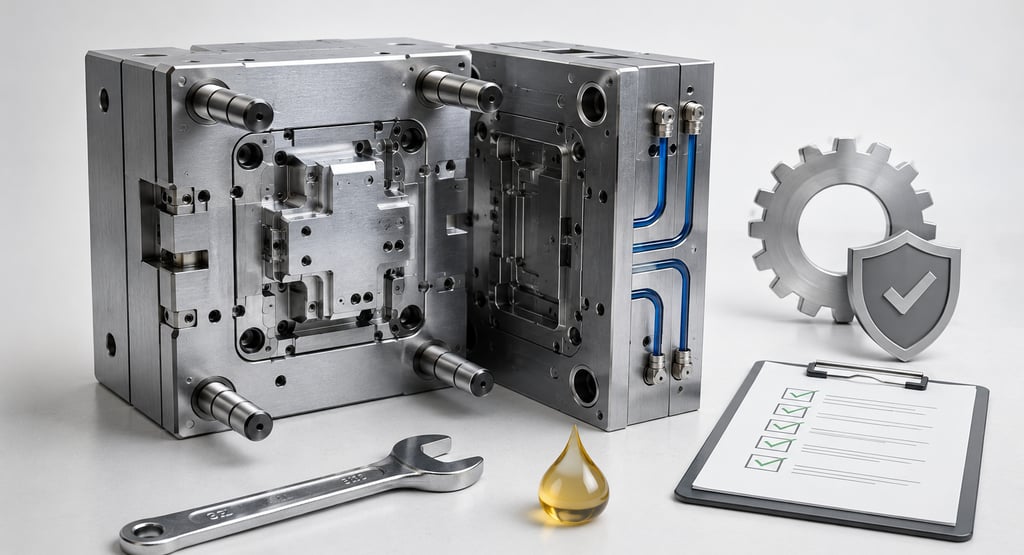
Preventive maintenance should include cleaning mold surfaces, checking moving mechanisms, inspecting ejector pins, lubricating sliders, checking cooling channels, and evaluating wear on closing surfaces.
In molds that are not maintained regularly, problems such as flash, part ejection issues, ejector marks, surface deterioration, slider jamming, and cooling inefficiency may occur over time. If these problems are not addressed early, mold revision becomes more costly.
5. Correct Lubrication
Moving components on the mold must be lubricated correctly. Sliders, moving cores, ejector plates, bushings, and moving mechanisms are continuously exposed to friction. If lubrication is insufficient, wear in these areas accelerates.
However, lubrication must be done with the correct product and in the correct amount. Excessive lubrication may cause contamination inside the mold, stains on plastic parts, or process problems. Insufficient lubrication increases mechanical wear.
For this reason, the mold maintenance plan should clearly define which areas will be lubricated, which oil or grease will be used, and how often lubrication will be performed.
6. Keeping Cooling Channels Clean
Cooling channels in plastic injection molds are critical for part quality and cycle time. Over time, lime scale, sediment, rust, or dirt may accumulate in these channels. These deposits reduce water flow and lower the cooling performance of the mold.
Insufficient cooling may cause warpage, dimensional deviation, sink marks, and longer cycle times. In addition, if temperature imbalance occurs inside the mold, some areas may be exposed to higher thermal stress.
Therefore, cooling channels should be checked regularly, water inlets and outlets should be monitored, and channel cleaning should be carried out when necessary.
7. Keeping Process Parameters Under Control
Injection molding process settings are another important factor affecting mold life. Excessively high injection pressure, excessive clamping force, incorrect temperature values, or unstable cycle times can create additional load on the mold.
For example, high injection pressure may increase stress on closing surfaces and raise the risk of flash. Incorrect temperature settings may cause the plastic material to burn inside the mold or leave residue on mold surfaces.
Approved process parameters should be recorded and monitored throughout production to detect any deviations from these values. A controlled process protects both part quality and mold life.
8. Using Suitable Plastic Material
The plastic material used also directly affects mold life. Glass fiber reinforced, mineral filled, or abrasive materials can create faster wear on mold surfaces. Some filled materials may also cause corrosion or residue buildup on mold surfaces.
Therefore, when selecting plastic material, not only product performance but also its effect on the mold should be evaluated. In molds working with glass fiber reinforced materials, gate points, runner areas, moving cores, and inserts may wear faster.
In such projects, more durable steel, suitable surface treatment, and a more frequent maintenance plan may be required.
9. Proper Mold Storage
When molds are not in production, they should be stored correctly. In molds that are not used for a long time, rust, moisture effects, surface contamination, or jamming in moving parts may occur.
Before a mold is placed in storage, it should be cleaned, its surfaces should be protected with protective oil, cooling channels should be drained, and moving mechanisms should be left in a suitable position. The mold should not be stored in a humid or unsuitable environment.
Proper storage ensures that the mold works smoothly when it is put back into production and prevents surface deterioration.
10. Keeping Maintenance Records
To extend mold life, it is important not only to perform maintenance but also to record it. Information such as when maintenance was performed on which mold, which parts were replaced, which failures were observed, and which revisions were applied should be tracked.
Thanks to maintenance records, the past performance of the mold can be analyzed. If wear continuously occurs in the same area, the situation should be re-evaluated in terms of design or process conditions.
A recorded maintenance system also provides major advantages for production planning and quality management. In this way, the maintenance process is based on a traceable system rather than personal memory.
Gri Kalıp’s Approach to Mold Life
At Gri Kalıp ve Plastik A.Ş., we aim for long-lasting and stable production performance in plastic injection molds. From mold design and steel selection to manufacturing and maintenance planning, all stages are evaluated by considering the long-term performance of the mold.
To extend mold life, correct steel selection, suitable machining methods, strong design, regular maintenance, and controlled production processes should be handled together. With this approach, molds are expected to operate reliably not only in the first production run but also throughout long-term mass production.
Conclusion
Extending mold life is an important subject that reduces costs and ensures quality continuity in plastic injection molding. Proper steel selection, suitable hardening, good mold design, regular maintenance, correct lubrication, clean cooling channels, and controlled process parameters directly affect mold life.
A long-lasting mold does not only mean lower maintenance cost. It also means fewer production stoppages, lower scrap rates, more stable quality, and more reliable delivery.
In successful plastic injection molding production, mold life should be managed holistically from the design stage to the maintenance process after production.
Frequently Asked Questions
How can the life of a plastic injection mold be extended?
Mold life can be extended through proper steel selection, suitable hardening, regular maintenance, correct lubrication, clean cooling channels, and controlled process parameters.
How is mold maintenance frequency determined?
Maintenance frequency should be determined according to the mold’s production quantity, plastic material used, mold structure, and working conditions. In high-volume production, a maintenance plan based on shot count should be created.
Do glass fiber reinforced plastics affect mold life?
Yes. Glass fiber reinforced plastics can create an abrasive effect. Therefore, correct steel selection, surface treatment, and regular maintenance are more important in molds working with these materials.
Do cooling channels affect mold life?
Yes. Clogged or inefficient cooling channels disturb mold temperature balance, extend cycle time, and negatively affect part quality. They should be checked regularly.
Why are mold storage conditions important?
If molds that are not in production are not cleaned and protected correctly, rust, moisture effects, and mechanical jamming may occur. Proper storage ensures that the mold can be put back into production smoothly.
Why should maintenance records be kept?
Maintenance records allow the past performance of the mold to be monitored. Repeated failures, replaced parts, and maintenance intervals can be recorded, making mold management healthier and more reliable.
Site Map
Home | About Us | Capabilities | Projects | Human Resources | Blog | Contact
CONTACT
Subscribe
+90 212 485 41 41
info@grikalip.com.tr
© 2024. All rights reserved.