
Advantages of Automation in Plastic Injection Molding
Robotic systems and automation solutions increase production speed while also contributing to quality standardization.
6/29/20266 min read
Advantages of Automation in Plastic Injection Molding
Meta Title: Advantages of Automation in Plastic Injection Molding | Gri Kalıp
Meta Description: Robotic systems and automation solutions in plastic injection molding provide significant advantages in terms of production speed, quality standards, occupational safety, and cost control.
URL Slug: advantages-of-automation-in-plastic-injection-molding
Blog Card Short Description: Robotic systems and automation solutions provide speed, quality standardization, and production efficiency in plastic injection molding. In this article, we examine the key advantages that automation offers to mass production.
Why Is Automation Important in Plastic Injection Molding?
Plastic injection molding is a manufacturing method that requires high-volume, repetitive, and precise process control. In projects where the same part is produced in thousands, hundreds of thousands, or millions of units, a good mold and correct machine settings alone are not enough. Production must continue in a fast, stable, safe, and traceable way.
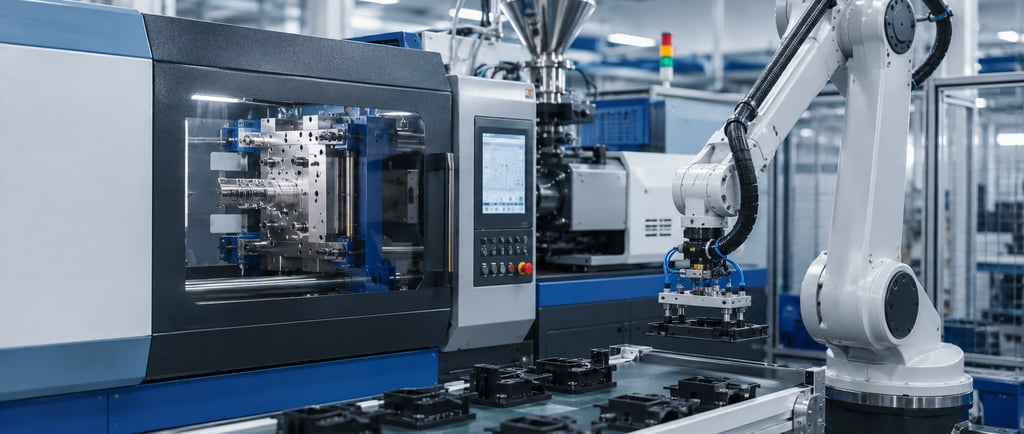
At this point, automation systems play an important role. Robotic arms, part removal systems, conveyors, automatic separation equipment, quality control systems, and packaging solutions make the production process more controlled.
The purpose of automation is not only to reduce human labor. The main goal is to ensure repeatable quality in production, maintain cycle time, reduce scrap rates, improve occupational safety, and increase production efficiency.
As competition increases in the plastic injection molding industry, controlling production costs and maintaining quality standards have become more important. For this reason, automation has become one of the essential elements of modern plastic injection molding production.
1. It Increases Production Speed
One of the most important advantages of automation systems is that they increase production speed. Manual part removal, runner separation, stacking, or handling operations depend on operator speed. Factors such as operator fatigue, distraction, or shift changes can affect production pace.
Robotic systems repeat the same movement in every cycle with the same speed and precision. When the mold opens, the part can be removed by the robot, placed on a conveyor, or transferred to a specific station. This makes cycle time more stable.
In high-volume production, even a few seconds of time savings can create a significant difference in total production capacity. Especially in multi-cavity molds, fast-cycle products, and mass production projects, robot-assisted production provides important efficiency advantages.
2. It Contributes to Quality Standardization
Quality in plastic injection molding is not only about producing the part correctly. The same part must be produced at the same standard throughout production. Automation helps achieve this repeatability.
In manual production, the way the part is removed, placed on a table, separated from the runner, or packaged may vary depending on the operator. This variability may cause scratches, deformation, mixing, or surface damage in some products.
In robotic systems, the part is gripped from the same point, moved at the same speed, and placed in the same way every time. This provides a major advantage, especially for products where visual surface quality is important.
Automation systems can also be integrated into quality processes such as separating defective parts, product counting, orientation control, or directing parts to specific test stations.
3. It Reduces Scrap Rate
Scrap is one of the most important factors that directly affects production cost. Problems such as defective parts, incorrect handling, breakage, scratching, or mixing can increase the scrap rate.
Automation systems reduce human-related variability in the production process. The part is removed from the mold in a controlled way, transferred properly, and placed in the correct area. This is especially important for delicate, thin-walled, glossy-surfaced, or easily scratched products.
In addition, in production lines combined with automatic quality control systems, defective parts can be detected at an early stage. This allows intervention before the problem grows.
Reducing scrap rate does not only save material. It also reduces labor, machine time, energy, and re-production costs.
4. It Improves Occupational Safety
Plastic injection molding machines operate with high temperature, high pressure, and moving mechanisms. Manual part removal or working close to the mold area may create occupational safety risks if not managed carefully.
In robotic production systems, the operator’s intervention in the mold area is reduced. Since the part removal process is carried out by the robot, the operator can work from a safer distance.
This is especially important for large molds, heavy parts, hot products, or fast-cycle production. Automation systems provide a more controlled and standardized working environment in terms of occupational safety.
Improved occupational safety is also an important advantage for production continuity and employee satisfaction.
5. It Reduces Operator Dependency
Operator experience is important in production; however, having the entire process depend on operator skill is not a sustainable system. Shift changes, new personnel, intense production pace, or distraction may cause quality variation.
Automation systems reduce operator dependency by standardizing repetitive operations. Instead of only removing parts, the operator’s role becomes monitoring the process, checking quality, and managing production flow.
This approach improves production discipline. It also allows operators to focus on more value-added tasks.
6. It Simplifies Packaging and Counting Processes
In plastic injection molding, products must be packed in correct quantities, without mixing, and prepared properly for shipment. Manual counting and packaging operations can carry a risk of error in high-volume production.
Automation systems can transfer products to conveyors, group them in defined quantities, direct them, or carry them to packaging stations. This reduces counting errors and makes the production flow more organized.
Automatic tracking and regular product flow provide advantages especially in jobs involving similar-looking parts, different colors, or model changes.
7. It Helps Keep Cycle Time Stable
Stable cycle time is very important in plastic injection molding. If cycle time constantly changes, production capacity, quality control planning, and delivery schedules may be negatively affected.
Manual part removal can extend or vary cycle time. Robotic systems, on the other hand, work in synchronization with the machine cycle and provide more balanced production.
Especially in projects requiring fast production, the robot’s compatibility with the machine helps maintain production rhythm. This also supports more accurate capacity planning.
8. It Provides Traceability and Production Data
Modern automation systems are not only mechanical motion equipment. They are also useful for collecting production data, monitoring product quantities, recording stoppages, and tracking quality processes.
In automation-supported production, the following data can be monitored more easily:
Number of parts produced
Cycle time
Number of defective parts
Downtime
Production efficiency
Packaging quantities
Operation repetitions
This data is an important source for analyzing production performance and carrying out continuous improvement.
9. It Provides Cost Advantages in High-Volume Production
Automation investment may seem like an additional cost at the beginning. However, in high-volume production, a correctly planned automation system can provide significant cost advantages in the long term.
Shorter cycle time, lower scrap rate, reduced labor requirement, more consistent quality, and a safer production environment reduce total production cost.
Especially in continuously running, high-volume, multi-cavity, or high-quality expectation projects, the return on investment of automation can be faster.
The important point is not to apply the same automation solution to every project. The correct automation level should be determined according to product geometry, production quantity, mold structure, cycle time, and quality expectations.
10. Is the Same Level of Automation Necessary for Every Production?
A high level of automation may not be necessary for every plastic injection molding production. In low-volume production, frequent product changes, or simple parts, manual systems may be more economical.
However, automation provides serious advantages in high-volume production, applications with strict quality expectations, situations where part removal carries risk, or projects where operator dependency should be reduced.
To make the right decision, the following questions should be evaluated:
Is the production quantity high?
Is cycle time critical?
Is the part delicate or easily scratched?
Does manual removal create scrap?
Are there errors in counting and packaging?
Will robot investment provide cost advantages in the long term?
The answers to these questions help determine whether automation investment is necessary.
Gri Kalıp’s Approach to Automation
At Gri Kalıp ve Plastik A.Ş., we consider automation in plastic injection molding as an important tool that improves production efficiency and quality continuity.
Applications such as robotic systems, automatic part removal, conveyor solutions, and process monitoring increase production speed while also contributing to quality standardization. In each project, product geometry, production quantity, quality expectations, and cost targets are evaluated together to determine the most suitable production method.
The goal is not only to produce faster, but to create a more controlled, more reliable, and more sustainable production system.
Conclusion
Automation in plastic injection molding offers significant advantages in terms of speed, quality, occupational safety, and cost control. Thanks to robotic systems and automation solutions, production cycles become more stable, scrap rates decrease, quality repeatability increases, and operator dependency is reduced.
In high-volume production with standard quality expectations, automation is a strong investment that provides competitive advantage. However, the correct automation level for each project should be determined through technical and economic analysis.
For successful plastic injection molding production, automation should be considered together with mold design, process control, and quality management.
Frequently Asked Questions
What does automation do in plastic injection molding?
Automation makes processes such as part removal, handling, counting, quality control, packaging, and production tracking faster, more standardized, and safer.
Does robot usage improve quality?
Yes. Robotic systems remove and transfer parts in the same way in every cycle, contributing to quality standardization. They can reduce scratches, deformation, and human-related variability.
Does automation reduce scrap rate?
Yes, when applied correctly. Controlled part removal, organized handling, and automatic inspection systems help reduce scrap rates.
Is a robot necessary in every plastic injection molding production?
No. A robot may not be necessary in low-volume or frequently changing production. However, automation provides major advantages in high-volume, sensitive, and fast production.
When does automation investment make sense?
Automation investment becomes reasonable when production quantity is high, cycle time is critical, manual operations create scrap, or labor cost increases production cost.
Does automation improve occupational safety?
Yes. In robotic systems, the operator’s intervention in the mold area is reduced. This lowers risks related to hot parts, moving molds, and fast cycles.
Site Map
Home | About Us | Capabilities | Projects | Human Resources | Blog | Contact
CONTACT
Subscribe
+90 212 485 41 41
info@grikalip.com.tr
© 2024. All rights reserved.