
Are Recycled Plastic Materials Reliable?
With a sustainable production approach, we evaluate the advantages of recycled plastics and the key technical points that should be considered.
6/29/20266 min read
Are Recycled Plastic Materials Reliable?
Meta Title: Are Recycled Plastic Materials Reliable? | Gri Kalıp
Meta Description: In which products can recycled plastic materials be used safely? Explore the advantages of recycled materials in plastic injection molding and the key technical criteria that should be considered.
URL Slug: are-recycled-plastic-materials-reliable
Blog Card Short Description: The use of recycled plastic materials is increasing with a sustainable production approach. In this article, we evaluate the advantages, risks, and key technical points to consider when using recycled materials in plastic injection molding.
What Is Recycled Plastic Material?
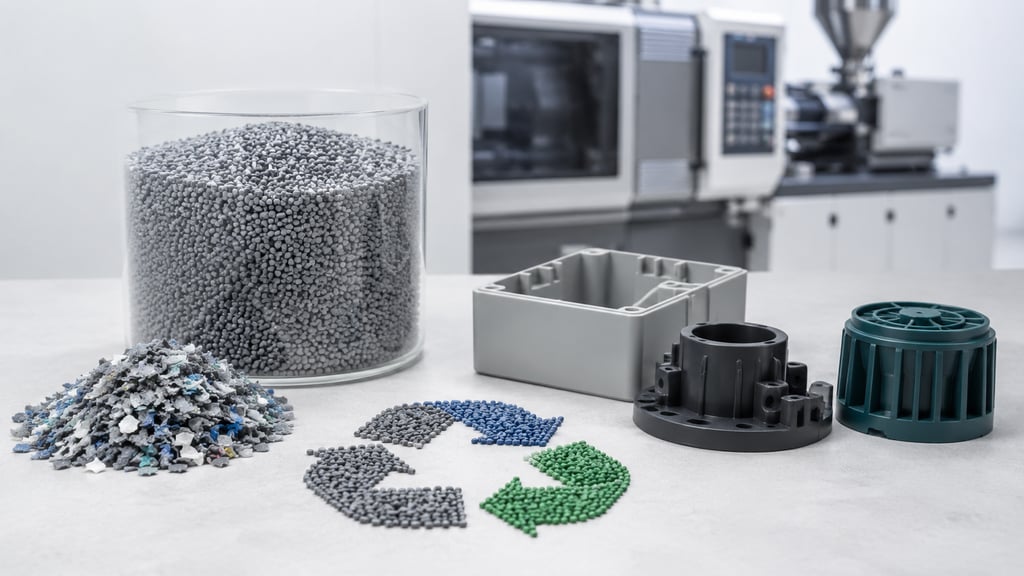
Recycled plastic material is a plastic material obtained by reprocessing previously used plastic products or plastic waste generated during production into granules. These materials can be reused in plastic injection molding and, when evaluated under the right conditions, can provide both environmental and economic advantages.
Recycled plastics can generally be divided into two main groups:
In-house recycled materials:
These are materials such as runners, defective parts, or production waste generated during plastic injection molding and reused after being ground. Since the source is known, they are easier to control.
Post-consumer recycled materials:
These are obtained by collecting, sorting, cleaning, grinding, and re-granulating used plastic products. Quality control becomes more critical for these materials.
The reliability of recycled plastics depends on the material source, sorting quality, cleanliness, additive structure, test results, and the application area of the product to be manufactured.
Are Recycled Plastics Reliable?
Recycled plastic materials can be used safely in many product groups when they are selected correctly and pass the right quality control processes. However, not every recycled material is suitable for every product.
For example, recycled material may be suitable for transport crates, non-technical plastic boxes, garden products, non-packaging auxiliary parts, or industrial products with low visual sensitivity. On the other hand, products that come into contact with food, medical parts, technical products requiring high strength, or tight-tolerance parts require much more careful evaluation.
Therefore, the use of recycled plastics should not be evaluated with a simple answer such as “reliable” or “not reliable.” The correct answer is: Recycled plastics can be used reliably with the right product, the right material, and the right quality control system.
Advantages of Recycled Plastics
The use of recycled plastic materials provides significant advantages in terms of sustainable production. Reintroducing plastic waste into the economy reduces natural resource consumption and lowers environmental impact.
In addition, recycled materials may provide cost advantages in certain product groups. Especially when the product has low aesthetic expectations, standard mechanical strength is sufficient, and the material source is stable, recycled material can be an economical alternative.
The main advantages are:
It supports more sustainable production.
It contributes to the reuse of plastic waste.
It may reduce material cost in certain products.
It can support carbon footprint reduction targets.
It allows in-house production waste to be reused.
It can respond to environmentally focused customer demands.
However, in order to achieve these advantages, the material should not be selected randomly; it should be selected according to technical criteria.
Technical Risks to Consider
The most important issue with recycled plastics is quality consistency. In virgin materials, technical values are more controlled. In recycled materials, however, properties may vary from lot to lot due to source variability, mixing risk, and previous usage history.
1. Risk of Material Mixing
Different plastic types may be mixed into recycled plastics. For example, if PE is mixed into PP, PS into ABS, or different filled materials are mixed together, flow behavior, strength, and surface quality may change during production.
This may cause brittleness, surface defects, color variation, or dimensional changes in the part.
2. Loss of Mechanical Strength
Plastics may be exposed to a certain level of thermal and mechanical degradation each time they are processed. Therefore, recycled materials may have lower impact strength, elongation, flexibility, or mechanical strength compared to virgin materials.
This is especially important for load-bearing, clipped, impact-resistant, or technical performance parts.
3. Color and Surface Quality Variation
It can be more difficult to maintain color consistency in recycled plastics. The previous color, additives, and mixing ratio of the material may affect the final product color.
For this reason, recycled materials are generally more suitable for black, dark gray, or low-visual-sensitivity products. Glossy, transparent, or color-critical products should be evaluated carefully.
4. Odor and Contamination Problems
In post-consumer recycled materials, cleaning and sorting quality are very important. Insufficiently cleaned materials may carry risks such as odor, foreign particles, moisture, metal particles, or organic residues.
Such problems can negatively affect both production quality and product use.
5. Flowability Variation
In recycled materials, the melt flow index, also known as MFI, may vary. When flowability changes, injection pressure, filling behavior, cycle time, and part dimensions may be affected.
For this reason, the flow behavior of the material should be tested before starting mass production.
What Controls Should Be Performed When Using Recycled Materials?
In order to use recycled plastics reliably, certain checks should be performed before and during production.
First, the material source must be reliable. If the same quality and same properties cannot be supplied continuously, quality variation may occur in mass production.
The main criteria to be checked are:
The material type should be correctly identified.
MFI / flowability value should be checked.
Density and additive ratio should be evaluated.
Moisture content and drying requirements should be determined.
Foreign material and contamination checks should be performed.
Color and surface quality should be tested.
Mechanical strength should be tested if required.
Lot-based tracking should be carried out.
Production behavior should be verified through trial molding.
Using recycled material directly in mass production without these controls can be risky.
In Which Products Can Recycled Plastics Be Used?
Recycled plastics can be used in many product groups. However, when determining the application area, the technical expectations, visual sensitivity, and safety requirements of the product should be considered.
Recycled materials may generally be more suitable for:
Industrial transport crates
Black non-technical plastic parts
Garden and outdoor products
Non-packaging auxiliary plastic parts
Storage and organizer products
Parts with low visual sensitivity
Some non-automotive, non-technical applications
In-house auxiliary production equipment
Areas that require more careful evaluation include:
Products that come into contact with food
Medical products
Children’s products
Parts requiring high impact resistance
Tight-tolerance technical parts
Transparent or glossy surface products
Parts requiring electrical safety
If recycled material will be used in these areas, relevant standards, customer specifications, and technical tests must be considered.
Use by Mixing with Virgin Material
In some projects, recycled plastic can be mixed with virgin material at certain ratios. This method may be preferred to achieve both cost advantage and more stable quality.
For example, using 10%, 20%, or 30% recycled material may be suitable for some products. However, as the ratio increases, mechanical properties, color, flowability, and surface quality may change.
For this reason, the mixing ratio should not be determined randomly. It should be verified through trial production and quality controls. In addition, the same ratio should be maintained and recorded throughout production.
Gri Kalıp’s Approach to Recycled Materials
At Gri Kalıp ve Plastik A.Ş., we consider recycled plastic materials an important option in terms of sustainable production. However, we also know that the same material approach is not correct for every product.
When evaluating the use of recycled material in a project, the product’s application area, mechanical expectations, visual quality requirements, customer specifications, and production stability should be analyzed together.
The goal is not only to reduce cost, but also to create a reliable, sustainable production process in which quality standards can be maintained.
Conclusion
Recycled plastic materials can be used reliably under the right conditions. However, these materials are not suitable for every product. Material source, quality consistency, mechanical properties, color stability, contamination risk, and production behavior must be evaluated carefully.
Recycled materials offer important advantages in terms of sustainable production. However, recycled materials used without technical control may cause quality problems, production scrap, and customer complaints.
For a successful application, the right product, the right material, the right mixing ratio, and the right quality control process should be managed together.
Frequently Asked Questions
Are recycled plastic materials reliable?
They can be reliable when sourced correctly, tested properly, and used in suitable products. However, not every recycled material is suitable for every product.
Are recycled plastics mechanically weaker?
In some cases, mechanical strength may be lower compared to virgin materials. Therefore, testing should be performed for products where impact resistance, flexibility, or load-bearing capacity is important.
Can recycled plastics be used in food-contact products?
For food-contact products, specific regulations, compliance documents, and approved material requirements must be considered. Not every recycled material is suitable for food contact.
Does recycled material affect color quality?
Yes. Color and surface quality may vary in recycled materials. For this reason, they are generally more suitable for black or dark-colored products with low visual sensitivity.
Can recycled material be mixed with virgin material?
Yes, in some projects it can be mixed at certain ratios. However, the mixing ratio should be tested, kept stable throughout production, and verified through quality control.
Does using recycled material reduce cost?
It can provide cost advantages in certain products. However, scrap rate, quality risk, testing requirements, and production stability should also be included in the total cost calculation.
Site Map
Home | About Us | Capabilities | Projects | Human Resources | Blog | Contact
CONTACT
Subscribe
+90 212 485 41 41
info@grikalip.com.tr
© 2024. All rights reserved.