Differences Between Hot Runner and Cold Runner Systems
Choosing the right runner system significantly affects production cost, cycle time, and material consumption. In this article, we compare the advantages and application areas of both systems.
6/29/20268 min read
Differences Between Hot Runner and Cold Runner Systems
Meta Title: Differences Between Hot Runner and Cold Runner Systems | Gri Kalıp
Meta Description: Explore the differences, advantages, disadvantages, and application areas of hot runner and cold runner systems in plastic injection molds.
URL Slug: differences-between-hot-runner-and-cold-runner-systems
Blog Card Short Description: Choosing the right runner system significantly affects production cost, cycle time, and material consumption. In this article, we compare the advantages, disadvantages, and application areas of hot runner and cold runner systems.
What Is a Runner System in Plastic Injection Molds?
In plastic injection molding, the runner system is the channel structure that allows molten plastic material to reach the mold cavities from the injection molding machine. The hot plastic coming from the machine first reaches the mold entry area and then flows through the runner channels and gate points into the mold cavity that forms the product.
Although the runner system may seem like a simple channel structure, it has a direct impact on plastic part quality and production efficiency. An incorrectly designed runner system may cause many problems such as short shots, weld lines, air traps, sink marks, flash, burn marks, unbalanced filling, and high scrap rates.
For this reason, runner system selection is one of the most critical decisions in plastic injection mold design. The two most commonly used systems are cold runner and hot runner systems.
What Is a Cold Runner System?
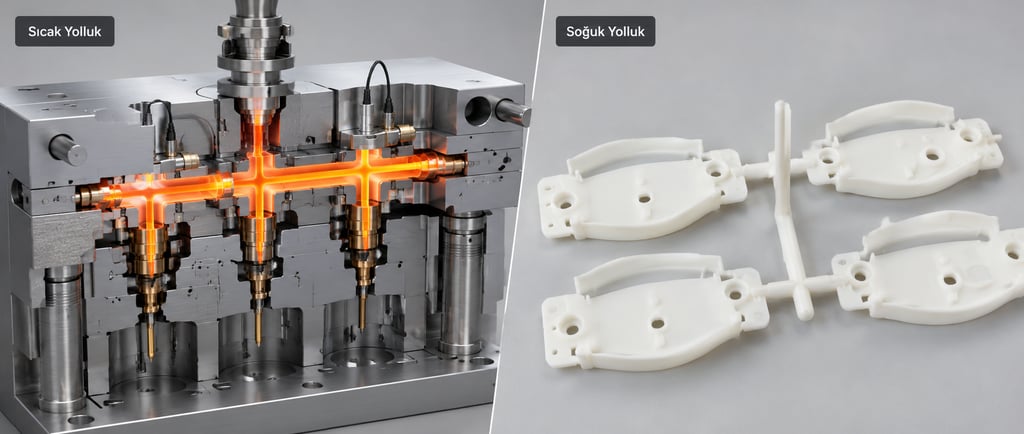
A cold runner system is one of the most basic and widely used runner systems in plastic injection molds. In this system, molten plastic is transferred to the product cavities through channels inside the mold. The plastic material fills both the product cavity and the runner channels inside the mold. When cooling is completed, the runner section is ejected from the mold together with the product.
A cold runner system includes the sprue, main runner, secondary runners, and gate areas. After the product is removed from the mold, the runner section is separated from the part. This separated section is generally considered scrap. In some materials, these runners can be ground and reused at certain ratios; however, this is not suitable for every product or every raw material.
Cold runner systems may be preferred especially in lower-volume production, simple parts, or projects where the initial mold investment cost needs to be kept low.
Advantages of Cold Runner Systems
The most important advantage of cold runner systems is that the mold investment cost is lower compared to hot runner systems. The system structure is simpler and does not require additional components such as a temperature control unit, manifold, heaters, or thermocouples.
Mold design and manufacturing are easier. Maintenance may also be simpler compared to hot runner systems. Especially if the production quantity is not very high or the material scrap amount does not create a major problem for the project, a cold runner system can provide an economical solution.
Cold runner systems may also be more practical for certain special materials or in production processes where frequent color changes are required. In hot runner systems, color change and cleaning processes may take longer in some cases.
Disadvantages of Cold Runner Systems
The most important disadvantage of a cold runner system is material waste. The runner section that comes out together with the product means extra material consumption for each cycle. In high-volume production, this scrap amount can create a significant cost.
Another disadvantage is cycle time. Since the runner section must also cool together with the product, the cycle time may increase. As runner thickness increases, cooling time also increases. This may reduce production capacity.
In addition, an extra operation may be required to separate the runner from the part. If this process is done manually, labor cost increases. If it is done through automation, additional equipment may be required. In some products, the runner break-off point may leave a visible mark or affect the aesthetic quality of the part.
What Is a Hot Runner System?
A hot runner system is an advanced runner system that keeps the plastic material hot and flowable inside the mold until it reaches the product cavity. This system includes a manifold, heaters, thermocouples, nozzle structures, and a temperature control unit.
In a hot runner system, the plastic material is fed directly into the product cavities without forming cold runner channels inside the mold. The molten plastic is kept hot inside the manifold and directed into the mold cavities through nozzle tips. As a result, runner waste does not come out with the product or is reduced to a minimum.
Hot runner systems are especially preferred in high-volume mass production, multi-cavity molds, projects where material cost is high, and production processes where cycle time is critical.
Advantages of Hot Runner Systems
One of the biggest advantages of hot runner systems is material savings. Since the scrap generated in cold runner systems is eliminated, significant cost advantages can be achieved, especially in high-volume production. This advantage becomes even more important when expensive engineering plastics are used.
Another important advantage is shorter cycle time. In a cold runner system, the runner must also cool, while in a hot runner system only the product needs to cool. This can increase production speed and allow the machine capacity to be used more efficiently.
Hot runner systems also offer advantages in balanced filling, especially in multi-cavity molds. With a properly designed manifold and nozzle system, each cavity can be fed more evenly. This is important for part weight, dimensional stability, and quality repeatability.
Since there is no runner separation process, post-production labor is also reduced. The part can come out of the mold cleaner and become more suitable for automation systems.
Disadvantages of Hot Runner Systems
The initial investment cost of hot runner systems is higher than that of cold runner systems. The manifold, nozzles, heaters, thermocouples, temperature controller, and special mold design create additional costs.
The system is also more complex. Maintenance and failure management require attention. Heater failure, thermocouple problems, nozzle blockage, or temperature imbalance can cause serious production stoppages. Therefore, design, assembly, and maintenance quality are very important in molds using hot runner systems.
Some materials must be managed carefully in hot runner systems. Heat-sensitive materials may degrade if they remain in the manifold for a long time, causing color change or burning problems. For this reason, material selection and temperature control must be done correctly.
In production processes with frequent color changes, hot runner cleaning may take more time compared to cold runner systems. This can create a disadvantage in certain production plans.
Main Differences Between Hot Runner and Cold Runner Systems
The main difference between hot runner and cold runner systems is how the plastic material is transferred inside the mold. In a cold runner system, the plastic cools inside the channels and is ejected from the mold together with the product. In a hot runner system, the plastic is kept hot inside the manifold and nozzles, and only the material entering the product cavity cools to form the part.
This difference directly affects material consumption, cycle time, mold cost, maintenance requirements, and production efficiency.
A cold runner system is a simpler and lower-cost solution. However, it may create disadvantages in terms of material waste and cycle time. A hot runner system is more expensive and technically more complex; however, in high-volume production, it can provide material savings, shorter cycle times, and more stable production.
Which System Should Be Preferred for Which Production Type?
When selecting a runner system, the decision should not be based only on mold cost. Annual production quantity, material price, part weight, number of cavities, cycle time target, visual quality expectations, and automation requirements should be evaluated together.
For low-volume products with simple geometries and low-cost materials, a cold runner system may be sufficient. In such cases, the investment cost of a hot runner system may not provide a meaningful return.
On the other hand, in high-volume production, multi-cavity molds, expensive engineering plastics, or projects with high runner waste, a hot runner system may be more advantageous. Although the initial investment cost is higher, it can reduce total cost in the long term through material savings and cycle time advantages.
Runner System Selection in Multi-Cavity Molds
In multi-cavity molds, runner system selection becomes more critical. Each cavity must be filled at the same time and under the same pressure and temperature conditions. Unbalanced filling may cause flash in some cavities, short shots in others, different part weights, and quality variations.
In cold runner systems, balanced runner design must be carried out carefully. Runner lengths, cross-sections, and gate locations should be calculated properly. In hot runner systems, manifold design and nozzle placement must be planned correctly.
Especially in high-volume and tight-tolerance products, a hot runner system can provide important advantages in terms of production stability.
The Effect of Runner System Selection on Cost
Looking only at the initial investment cost in a mold project can be misleading. In a cold runner system, the mold cost may seem lower; however, the runner waste generated in every cycle can turn into a serious raw material cost in the long term.
In a hot runner system, the initial investment cost is higher; however, scrap is reduced, cycle time may be shortened, and production efficiency can increase. Therefore, the correct decision should be based on a total cost calculation.
The following criteria should be considered in this calculation:
Annual production quantity of the product
Part and runner weight
Kilogram price of the material used
Difference in cycle time
Machine hourly cost
Maintenance and energy costs
Mold investment cost
Labor and automation requirements
Choosing the right system provides important advantages in terms of both cost and quality throughout the production process.
Gri Kalıp’s Approach to Runner System Selection
At Gri Kalıp ve Plastik A.Ş., we consider runner system selection in plastic injection mold projects not only as a technical detail, but also as a strategic decision that determines the efficiency of the project.
In every project, product geometry, production quantity, material type, number of cavities, quality expectations, and cost targets should be analyzed together. In some projects, a simple and economical cold runner system may be the right solution, while in others, a hot runner system may provide much more efficient results in the long term.
The right runner system is an important factor for high-quality production, low scrap rates, shorter cycle times, and sustainable cost advantages.
Conclusion
Hot runner and cold runner systems are two important solutions that directly affect production efficiency and part cost in plastic injection molds.
A cold runner system offers a simpler, more economical, and easier-to-maintain structure. However, it may have disadvantages such as runner waste, additional labor, and longer cycle time.
A hot runner system requires a higher initial investment cost; however, it can provide material savings, shorter cycle times, and more stable quality in high-volume production.
The right choice should be made according to the technical requirements and production targets of the product. In a successful plastic injection molding project, the runner system is one of the most important decisions in mold design.
Frequently Asked Questions
What is a hot runner system?
A hot runner system is a runner system that keeps the plastic material hot inside the manifold and nozzles and feeds it directly into the product cavities. In this system, runner waste is minimized or completely eliminated.
What is a cold runner system?
A cold runner system is a system in which molten plastic material is transferred to the product cavities through channels inside the mold, and the runner section is ejected from the mold together with the product.
Which is more advantageous: hot runner or cold runner?
This decision depends on production quantity, material cost, part geometry, number of mold cavities, and quality expectations. In high-volume production using expensive materials, hot runner systems may be more advantageous. In low-volume production, cold runner systems may be more economical.
Does a hot runner system reduce material waste?
Yes. In a hot runner system, plastic material is fed directly into the product cavities, so the runner waste generated in cold runner systems is largely eliminated.
Can the waste from a cold runner system be reused?
In some materials, runners can be ground and reused at certain ratios. However, this depends on the product’s quality expectations, material type, and customer specifications. For technically or visually sensitive products, the regrind ratio should be evaluated carefully.
Are hot runner systems preferred in multi-cavity molds?
Yes. In multi-cavity molds, hot runner systems can provide advantages in balanced filling, low scrap rates, and shorter cycle times. However, the system must be designed correctly and temperature control must be managed properly.
Site Map
Home | About Us | Capabilities | Projects | Human Resources | Blog | Contact
CONTACT
Subscribe
+90 212 485 41 41
info@grikalip.com.tr
© 2024. All rights reserved.