
Energy Efficiency in Plastic Injection Molding
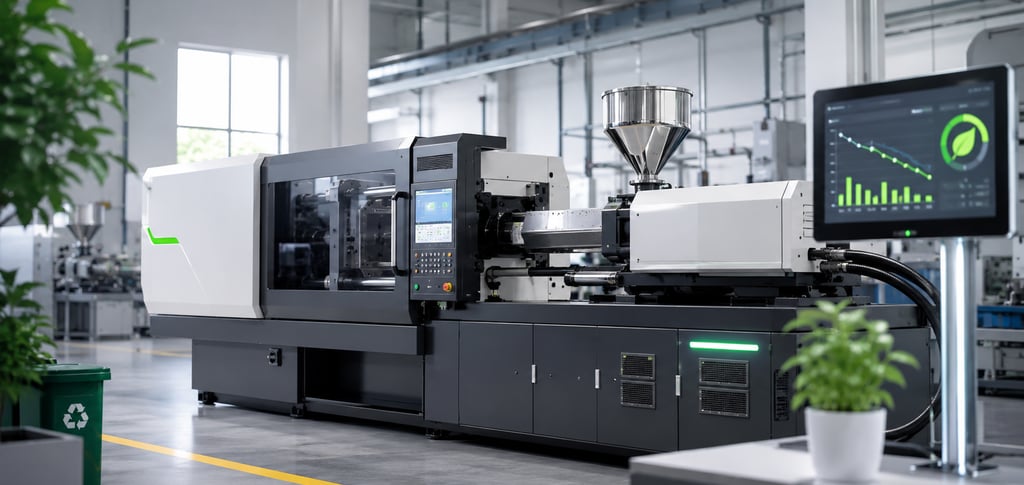
Modern servo injection molding machines significantly reduce energy consumption while contributing to sustainable production.
6/29/20265 min read
Energy Efficiency in Plastic Injection Molding
Meta Title: Energy Efficiency in Plastic Injection Molding | Gri Kalıp
Meta Description: Energy efficiency in plastic injection molding is achieved through modern injection molding machines, correct process settings, cycle optimization, and a sustainable production approach.
URL Slug: energy-efficiency-in-plastic-injection-molding
Blog Card Short Description: Modern servo injection molding machines reduce energy consumption, while proper process management and cycle optimization support efficiency and sustainability in plastic injection molding.
Why Is Energy Efficiency Important in Plastic Injection Molding?
Plastic injection molding is a manufacturing method where energy consumption is significant due to high temperature, high pressure, and repetitive machine movements. Injection molding machines, dryers, mold temperature controllers, cooling systems, compressors, and auxiliary equipment continuously consume energy during the production process.
For this reason, energy efficiency is an important subject in the plastic injection molding industry in terms of both cost control and sustainable production. More efficient production means lower energy consumption, a more stable process, less scrap, and more controlled production costs.
Energy efficiency is not only related to the machine technology used. Mold design, process parameters, cycle time, maintenance practices, material preparation, and quality control processes also directly affect total energy usage.
Contribution of Servo Injection Molding Machines to Energy Efficiency
One of the most important technologies that reduces energy consumption in plastic injection molding is servo motor injection molding machines. In traditional hydraulic machines, motors often run continuously, while in servo systems, energy is used according to actual demand.
Servo injection molding machines consume energy only during the required movement and at the required power level. This provides significant efficiency advantages, especially in long-term mass production.
The main advantages of servo machines are:
They provide lower energy consumption.
They control machine movements more precisely.
They contribute to more stable cycle times.
They support repeatable quality in production.
They offer quieter and more controlled operation.
They reduce unnecessary energy losses.
A modern machine park makes it easier to manage quality and efficiency together in plastic injection molding production.
How Does Cycle Time Affect Energy Consumption?
In plastic injection molding, cycle time is the total time required to produce one part. As cycle time increases, the machine, mold temperature controller, cooling system, and auxiliary equipment operate for a longer period. This increases energy consumption.
However, simply shortening the cycle time is not the right approach. If the part is removed from the mold before it has cooled sufficiently, warpage, dimensional deviation, or deformation may occur. Therefore, the goal is to achieve the most efficient cycle time without compromising quality.
Proper cycle optimization should be carried out by evaluating mold cooling design, process settings, material behavior, and machine capacity together.
The Effect of Mold Cooling Design on Energy Efficiency
Cooling design in injection molds affects both part quality and energy consumption. Insufficient or unbalanced cooling requires a longer waiting time before the part can be removed from the mold. This increases cycle time and energy consumption.
Properly designed cooling channels allow the part to cool more evenly and in a shorter time. As a result, dimensional stability improves and production efficiency increases.
With a good cooling design:
Cycle time is optimized.
Part quality becomes more stable.
Scrap rate decreases.
Machine operating time is used more efficiently.
Total production cost may decrease.
For this reason, the cooling system is not only a technical detail of mold design; it is also an important factor that determines production efficiency.
Process Settings and Energy Usage
Process parameters in plastic injection molding have a direct effect on energy consumption. Excessively high injection pressure, unnecessary temperature levels, long holding time, or unnecessarily long cooling time can increase energy consumption.
Correct process settings allow the part to be produced with the required quality under the most efficient production conditions. For this purpose, injection temperature, mold temperature, injection pressure, holding pressure, holding time, screw speed, and cooling time should be optimized carefully.
The goal in energy efficiency is not to randomly reduce process values. The important point is to prevent unnecessary energy usage while maintaining product quality.
Efficient Use of Auxiliary Equipment
In plastic injection molding, energy is not consumed only by the injection molding machine. Dryers, material handling systems, mold temperature controllers, chiller systems, compressors, and robots also have a significant share in total energy usage.
Correct selection, regular maintenance, and proper capacity usage of this equipment are important for energy efficiency. Dryers operating at unnecessarily high temperatures, inefficient compressors, or clogged cooling circuits may cause unnecessary energy loss.
Therefore, energy efficiency should not be evaluated only on a machine basis, but by considering the entire production line.
Reducing Scrap Rate Contributes to Energy Efficiency
Energy efficiency does not only mean reducing electricity consumption. Every defective part produced consumes energy, raw material, machine time, and labor.
For this reason, a low scrap rate is also an important part of energy efficiency. Scrap rate can be reduced through correct mold design, stable process settings, proper material management, and regular quality control.
As scrap decreases, more high-quality products can be produced with the same amount of energy. This positively affects both production cost and resource usage.
Sustainable Production Approach
Energy efficiency is one of the important topics in today’s plastic injection molding production. More efficient machines, correct process management, low scrap rates, and the use of renewable energy support a sustainable production approach.
Gri Kalıp ve Plastik A.Ş. values the use of green energy obtained from renewable sources in its production activities and documents this approach with an I-REC certificate. Within the scope of Scope 2 carbon reporting for our company’s energy consumption, 0 CO₂ emissions have been reported. Our I-REC certificate can be shared upon request by contacting our company.
This approach is a complementary element of trust, especially for customers who value sustainable supply chains and environmental responsibility.
What Does Energy Efficiency Provide for Customers?
Energy-efficient production processes also create various advantages for customers. More controlled energy usage, more efficient production, and lower scrap rates contribute to a more stable cost structure in the long term.
In addition, for companies with sustainability targets, working with environmentally responsible suppliers can be an important preference.
Energy-efficient production can provide the following advantages for customers:
More stable production quality
Lower scrap risk
More controlled production cost
More efficient supply process
Contribution to a sustainable supply chain
Environmentally responsible production approach
Gri Kalıp’s Approach to Energy Efficiency
At Gri Kalıp ve Plastik A.Ş., we consider energy efficiency in plastic injection molding as an important subject in terms of production quality, cost control, and sustainability.
More efficient production is targeted through modern injection molding machines, correct process management, cycle optimization, quality control processes, and regular maintenance practices.
Our goal is not only to manufacture products, but also to provide value to our customers with a high-quality, sustainable production approach that uses resources more efficiently.
Conclusion
Energy efficiency in plastic injection molding is achieved through modern servo machines, correct process settings, good mold cooling design, low scrap rates, and efficient use of auxiliary equipment.
Energy efficiency contributes to controlling production costs and strengthening a sustainable production approach. In today’s increasingly competitive plastic injection molding industry, efficient production is not only a cost advantage, but also an important value in terms of quality and environmental responsibility.
Frequently Asked Questions
How is energy efficiency achieved in plastic injection molding?
Energy efficiency can be achieved through servo injection molding machines, correct process settings, short and stable cycle times, good cooling design, low scrap rates, and efficient use of auxiliary equipment.
Do servo injection molding machines save energy?
Yes. Servo machines can operate more efficiently than traditional systems because they adjust energy demand according to production movements.
Does mold cooling design affect energy consumption?
Yes. Correct cooling design optimizes cycle time and improves production efficiency. Insufficient cooling may mean longer cycle times and higher energy consumption.
Does scrap rate affect energy efficiency?
Yes. Every defective part consumes energy, raw material, and time. Reducing scrap rate contributes to overall energy efficiency.
Does energy efficiency reduce production cost?
Yes, when applied correctly. More efficient machines, optimized cycle times, and lower scrap rates can help reduce total production cost.
Site Map
Home | About Us | Capabilities | Projects | Human Resources | Blog | Contact
CONTACT
Subscribe
+90 212 485 41 41
info@grikalip.com.tr
© 2024. All rights reserved.