INFO@GRIKALIP.COM.TR - GET A QUOTE FOR YOUR PROJECTS BY CONTACTING US - INFO@GRIKALIP.COM.TR
How to Achieve High-Quality Plastic Parts in Mass Production?
High quality is not achieved only with a good mold; it is also possible through correct machine settings, process control, and quality management. In this article, we examine the key criteria required for sustainable quality in mass production.
6/29/20268 min read
How to Achieve High-Quality Plastic Parts in Mass Production?
Meta Title: How to Achieve High-Quality Plastic Parts in Mass Production? | Gri Kalıp
Meta Description: How should mold design, machine settings, process control, and quality management be applied to achieve high-quality plastic parts in mass production?
URL Slug: how-to-achieve-high-quality-plastic-parts-in-mass-production
Blog Card Short Description: High quality is not achieved only with a good mold; it is also made possible through correct machine settings, process control, material management, and a reliable quality monitoring system. In this article, we examine the key criteria required for sustainable quality in mass production.
Why Is Quality in Mass Production Not Limited to the Mold?
A well-designed and properly manufactured mold is highly important for producing high-quality plastic parts in plastic injection molding. However, maintaining quality in mass production does not depend only on the success of the mold. Parts produced from the same mold may show different quality results due to different machine settings, material conditions, operator practices, or uncontrolled production environments.
For this reason, quality in plastic injection molding is achieved through the combined operation of mold design, material selection, injection molding machine settings, process control, maintenance management, and quality control processes. Especially in high-volume production, even a small process deviation can result in thousands of defective parts.
The goal in mass production is not only to produce the first part correctly. The real objective is to maintain the same quality standard repeatedly throughout the entire production process. This is possible through systematic production management, recorded process parameters, and regular quality monitoring.
1. Correct Mold Design Is the Foundation of Quality
The first step in producing high-quality plastic parts is correct mold design. Mold design does not only create the shape of the part; it also directly affects surface quality, dimensional accuracy, cycle time, demolding behavior, and production stability.
In mold design, the parting line, runner system, gate location, cooling channels, ejector system, venting areas, and moving mechanisms must be planned carefully. If one of these details is designed incorrectly, problems such as flash, sink marks, short shots, burn marks, warpage, or dimensional deviations may occur in mass production.
For example, an incorrectly positioned gate may cause weld lines or filling problems in certain areas of the part. Insufficient cooling channels may lead to uneven cooling and warpage. Therefore, high-quality mass production starts with correct engineering work before production begins.
2. Material Selection and Material Management
In mass production, choosing the right plastic material is important, but managing the material correctly during production is just as critical. When the material used for the same product changes, part dimensions, surface quality, mechanical strength, and process behavior may also change.
Each plastic material, such as PP, ABS, PC, PA, POM, or PET, has different flow characteristics, shrinkage rates, moisture absorption tendencies, and temperature behavior. Therefore, mold and process settings must be planned according to the material to be used.
Drying is especially critical for engineering plastics that tend to absorb moisture. Insufficiently dried materials may cause silver streaks, bubbles, loss of mechanical strength, or processing problems. When material lot changes occur, production parameters and part quality should be checked again.
For effective material management in mass production, the following points should be considered:
Materials should be stored under proper conditions.
Materials with moisture absorption risk should be dried correctly before production.
Material lot numbers should be recorded.
Color masterbatch ratios should be applied in a controlled way.
If recycled or regrind material is used, its ratio should be standardized.
Correct material management is one of the most important steps for quality continuity in production.
3. Correct Machine Settings
Machine settings have a direct effect on part quality in plastic injection molding. If parameters such as injection temperature, mold temperature, injection speed, injection pressure, holding pressure, holding time, cooling time, and cycle time are not controlled, quality problems become unavoidable.
For example, if injection pressure is insufficient, the part may not fill completely. If the pressure is too high, flash may occur. If holding pressure or holding time is too low, sink marks may appear. If mold temperature is unbalanced, warpage or dimensional deviation may occur.
For this reason, an ideal process window should be created for each product. A process window refers to the safe production range in which the part meets the required quality standard. Once this range is defined, machine settings should be standardized and maintained throughout production.
For high-quality mass production, machine settings should not depend only on operator experience. Approved parameters should be recorded and used as reference values in repeat production.
4. Process Control and Production Monitoring
One of the most important factors that makes quality sustainable in mass production is process control. During production, small changes may occur in the machine, mold, material, or environmental conditions. If these changes are not noticed in time, defective production may continue for a long period.
In process control, injection pressure, cycle time, mold temperature, part weight, and critical dimensions should be monitored regularly. Part weight is a practical and effective quality indicator. Deviations in weight can provide early warning about filling, holding pressure, or material changes.
In addition, first article approval should be carried out during production, sample checks should be performed at defined intervals, and critical dimensions should be recorded. This system enables defects to be detected during production rather than after production is completed.
Without process control, quality is left to chance. In controlled production, quality becomes measurable, traceable, and repeatable.
5. Mold Temperature and Cooling Management
In plastic injection molding, the cooling process directly affects both quality and production efficiency. Balanced cooling of the part inside the mold is critical for dimensional stability, surface quality, and cycle time.
Uneven cooling may cause warpage, internal stress, dimensional deviation, or surface waviness. Mold temperature must be managed carefully, especially in large-surface, thin-walled, or tight-tolerance parts.
To keep mold temperature stable, water channels, temperature controllers, and cooling equipment should be monitored regularly. If there is clogging, scaling, or insufficient flow in the cooling channels, the mold cannot deliver the expected performance.
For high-quality parts in mass production, the cooling system should be controlled not only during mold design but also throughout production.
6. Dimensional Control and Visual Control
In high-quality plastic part production, dimensional control and visual control should be evaluated together. A part may look perfect from the outside but may not meet the dimensions specified in the technical drawing. Similarly, a part with correct dimensions may still have surface defects, color differences, or flash problems.
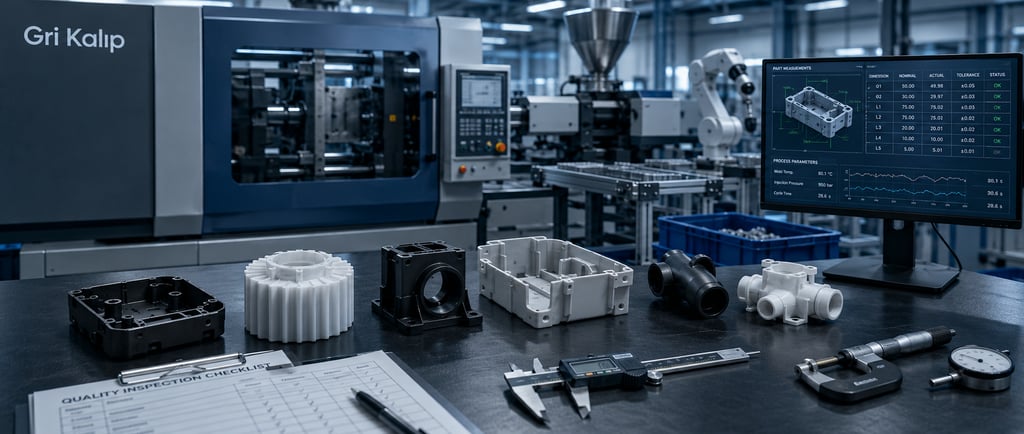
In dimensional control, calipers, micrometers, gauges, fixtures, or coordinate measuring machines may be used. The control method should be determined according to the precision and application area of the part. Critical dimensions should be monitored at the beginning, during, and at the end of production.
In visual control, defects such as flash, sink marks, burn marks, color differences, scratches, surface waviness, weld lines, and deformation are examined. Visual quality criteria should be defined in advance and clearly communicated to operators.
For quality control to be effective, acceptance and rejection criteria must be clear. The question “Is this part acceptable or not?” should not be left to personal interpretation. When standards are clearly defined, quality becomes more sustainable.
7. Operator Training and Production Discipline
Modern injection molding machines, high-quality molds, and good materials provide major advantages in production. However, the human factor is still important in mass production. Operators must know the product, understand quality criteria, stop the process when they notice a defect, and report problems correctly.
Operators should be informed about the critical areas of the product, inspection frequency, packaging method, flash control, visual quality expectations, and actions to be taken in case of defects. Untrained operators may fail to notice defective parts or may cause quality problems to grow.
Production discipline is especially important in high-volume jobs. Standard work instructions, control forms, production tracking cards, and packaging instructions should be used to make the process clear.
8. Mold Maintenance and Machine Maintenance
Mold and machine maintenance should not be neglected if high-quality parts are expected in mass production. Over time, mold surfaces may wear, ejector systems may become dirty, sliders may loosen, water channels may become clogged, or parting lines may deform. These issues can cause flash, surface defects, dimensional deviations, or demolding problems.
Mold maintenance should not be carried out only when a failure occurs. A periodic maintenance plan should be created according to defined production quantities. Mold cleaning, lubrication, ejector system checks, water connections, and closing surfaces should be inspected regularly.
Similarly, the condition of the injection molding machine’s screw and barrel, temperature control system, hydraulic or servo systems, and clamping performance can also affect quality. Machine maintenance is an important part of production stability.
9. Packaging and Shipment Quality
High-quality plastic part production does not end when the product comes out of the machine. If parts are not packaged correctly after production, scratches, crushing, deformation, or mixing problems may occur. Especially for products where visual surface quality is important, the packaging process is as important as production.
Separators, bags, cartons, or special transport boxes may be used to prevent parts from rubbing against each other. Products should be labeled according to customer instructions, lot information should be traceable, and shipments should be prepared in a way that prevents damage during transportation.
In mass production, quality is evaluated based on the final product received by the customer. Therefore, packaging and logistics should be considered part of the quality system.
Gri Kalıp’s Quality Approach in Mass Production
At Gri Kalıp ve Plastik A.Ş., we consider quality in plastic injection molding not only as a final inspection stage but as a system applied throughout the entire production process. From mold design and material selection to machine settings, process control, dimensional inspections, and packaging, sustainable quality is targeted at every stage.
Thanks to our experience in plastic part production for different industries, we evaluate each project according to its own technical requirements and aim to develop manufacturable, dimensionally stable, and reliable long-term solutions.
The foundation of high-quality mass production is correct planning, disciplined implementation, and continuous control. With this approach, scrap rates decrease, delivery reliability increases, and customer satisfaction becomes sustainable.
Conclusion
Achieving high-quality plastic parts in mass production is not possible only by having a good injection mold. Correct material selection, proper machine settings, controlled process management, regular quality control, mold maintenance, and a trained production team must work together.
Quality is not a result that is inspected only at the end of production; it is a process that is planned and managed from the beginning. Therefore, every stage in successful plastic injection molding production should be measurable, traceable, and repeatable.
A properly managed mass production process provides lower scrap rates, more stable quality, more efficient production, and stronger customer confidence.
Frequently Asked Questions
How is plastic part quality maintained in mass production?
To maintain quality, approved process parameters should be recorded, material lots should be tracked, regular dimensional and visual inspections should be carried out, and mold maintenance should be performed according to a planned schedule.
What is the most important factor in producing high-quality plastic parts?
A single factor is not enough. Mold design, material selection, machine settings, process control, and quality management should be evaluated together.
Do injection molding machine settings affect quality?
Yes. Injection pressure, speed, temperature, holding pressure, holding time, and cooling time directly affect part quality. Incorrect settings may cause sink marks, flash, short shots, warpage, or surface defects.
Why is mold maintenance important?
Regular mold maintenance helps prevent flash, dimensional deviations, ejector marks, surface defects, and production stoppages. It also extends mold life and protects mass production quality.
How is quality control carried out on plastic parts?
Quality control can include dimensional inspection, visual inspection, functional testing, weight control, and customer-specific criteria. The control method should be determined according to the application area and technical sensitivity of the part.
Why is process control necessary?
Process control helps detect deviations that may occur during production at an early stage. This allows intervention before defective production grows and helps maintain quality continuity in mass production.
Site Map
Home | About Us | Capabilities | Projects | Human Resources | Blog | Contact
CONTACT
Subscribe
+90 212 485 41 41
info@grikalip.com.tr
© 2024. All rights reserved.