How to Select Steel for an Injection Mold?
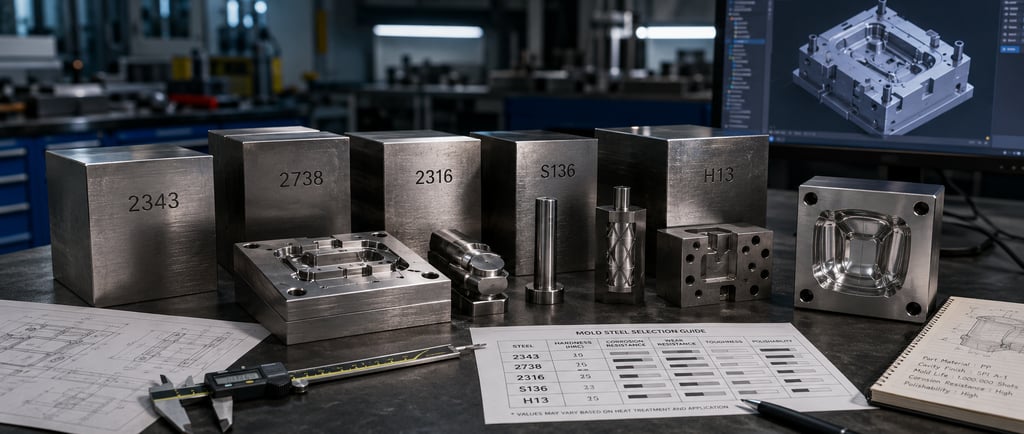
2343, 2738, 2316, S136, H13… The mold steel used may vary depending on the product’s production volume and plastic material. In this article, we cover the key points of selecting the right steel.
6/29/20267 min read
How to Select Steel for an Injection Mold?
Meta Title: How to Select Steel for an Injection Mold? | Gri Kalıp
Meta Description: Explore the application areas of 2738, 2738HH, 2344, 2343, C45, and 2379 steels in plastic injection molds and the impact of correct steel selection on mold life.
URL Slug: how-to-select-steel-for-an-injection-mold
Blog Card Short Description: The steel used in a plastic injection mold is determined according to the product’s production volume, plastic material, surface expectations, and working conditions. In this article, we examine the key criteria for correct steel selection based on the 2738, 2738HH, 2344, 2343, C45, and 2379 steels used in Gri Kalıp’s production processes.
Why Is Steel Selection Important in Injection Molds?
Steel selection in plastic injection molds is a critical decision that directly affects mold life, production performance, maintenance requirements, and the quality of the plastic part to be produced. Even if the mold design is correct, if the selected steel is not suitable for the project requirements, problems such as wear, flash, dimensional deviation, surface deterioration, demolding issues, or unexpected mold stoppages may occur during mass production.
For this reason, there is no single answer to the question, “What is the best steel for an injection mold?” The right question is: Which steel is most suitable for this product, this plastic material, this production volume, and these working conditions?
A mold is not usually manufactured from only one type of steel. Mold body components, cavity and core areas, inserts, sliders, moving cores, support plates, and special parts exposed to wear can be manufactured from different steels. This approach helps balance cost while achieving higher performance in the critical areas of the mold.
At Gri Kalıp ve Plastik A.Ş., different steel groups such as 2738, 2738HH, 2344, 2343, C45, and 2379 are used in plastic injection molds depending on project requirements. Each steel type is selected according to its function in the mold and the production conditions.
Main Criteria That Determine Steel Selection
When selecting steel for a plastic injection mold, the technical requirements of the product should be evaluated first. Production volume, plastic material, part geometry, surface expectations, dimensional tolerances, and mold working conditions should be analyzed together.
Production Volume
The number of shots the mold is expected to produce is an important criterion in steel selection. For low-volume production, more economical and easily machinable steels may be sufficient. However, for high-volume mass production, more durable steels with higher hardness values or steels that can be strengthened through heat treatment should be preferred.
In high-volume production, saving on steel may seem advantageous in the short term, but it can increase maintenance, revision, and production stoppage costs in the long term.
Plastic Material Type
The plastic material to be used is a direct determining factor in steel selection. A different steel approach may be preferred for molds working with standard materials such as PP, ABS, and PE, while more durable steels may be required for glass fiber reinforced PA, PBT, PET, or materials containing abrasive additives.
Glass fiber reinforced materials can cause wear on mold surfaces. In such projects, gate areas, moving cores, inserts, and fine details require more careful steel selection.
Surface Quality
The surface expectation of the plastic part also affects steel selection. In products where visual surface quality is important, machinability, polishability, and surface stability of the steel become more important. In technical parts, strength, dimensional stability, and long mold life are often more important than surface gloss.
Mold Structure and Moving Components
In molds with sliders, moving cores, inserts, or areas exposed to high mechanical stress, different steels may need to be used together. Since friction, impact, pressure, and wear risks are higher in moving areas, more durable steels are preferred in these regions.
2738 Plastic Mold Steel
2738 is one of the widely used pre-hardened plastic mold steels in plastic injection molds. It offers good machinability, a strong cost-performance balance, and suitability for general-purpose plastic injection molds.
It can be preferred in medium and large-scale plastic injection molds, especially in projects using standard plastic materials such as PP, ABS, PE, and HIPS. 2738 steel provides a balanced solution for mold bodies and product-forming areas.
This steel type can be an economical and technically suitable choice for molds where very high wear resistance is not required but stable mass production performance is expected. In large-volume molds, its homogeneous hardness structure and machinability provide advantages during the manufacturing process.
However, in projects with very high production volumes, glass fiber reinforced materials, or high wear risk, higher-performance alternatives or additional insert solutions in critical areas should be evaluated instead of using only 2738.
2738HH Plastic Mold Steel
2738HH can be considered a higher-hardness version of 2738 steel. It can be preferred in plastic injection molds where higher strength, better wear resistance, and longer mold life are targeted.
2738HH provides advantages especially in higher-volume production, mold areas exposed to greater mechanical stress, or projects where higher performance is expected compared to standard 2738.
This material offers a balanced solution in terms of both machinability and strength in mold manufacturing. In high-volume mass production, it can help mold surfaces remain stable for a longer period.
When selecting 2738HH, production quantity, the abrasive effect of the plastic material, and mold working conditions should be evaluated together. The highest hardness is not always necessary for every project; however, in projects targeting long mold life and lower maintenance requirements, 2738HH can be a suitable alternative.
2343 and 2344 Hot Work Steels
2343 is also considered within the hot work steel group and is a strong steel type in terms of toughness and temperature resistance. In plastic injection molds, it can be used especially in technical components exposed to mechanical stress.
2343 can be preferred in moving cores, inserts, moving mechanism elements, and heavily working mold areas where high strength is required. Its performance can be improved through heat treatment, providing more stable operation in long-term production.
2343 and 2344 steels can be evaluated in similar application areas. Which steel should be selected depends on project conditions, the required hardness value, part geometry, and the technical evaluation of the mold manufacturer.
Especially in areas operating under friction, impact, or high mechanical load, correct hot work steel selection is important for mold reliability.
C45 Support Material
C45 is an economical and easily machinable steel type generally used in mold manufacturing for support, carrier, or backing plate applications. It is often not necessary to use high-alloy mold steel in every area of a plastic injection mold. Therefore, materials such as C45 can be preferred in areas that do not form the product surface and mainly serve a supporting function.
The advantage of C45 is its balance of cost, machinability, and general mechanical strength. It can be used in support plates, backing plates, or auxiliary regions within the mold set that do not directly form the plastic part surface.
However, C45 is generally not preferred for critical surfaces that form the product and are exposed to wear. Special plastic mold steels are more suitable for areas that come into direct contact with plastic, require precise dimensions, or have high surface quality expectations.
When used correctly, C45 helps balance mold cost and prevents unnecessary high steel costs.
2379 Cold Work Steel
2379 is a cold work steel known for its high wear resistance and hardenability. In plastic injection molds, it can be used especially in special components exposed to wear, sharp details, sliders, inserts, or areas requiring high durability.
2379 can reach high hardness values after heat treatment. Therefore, it provides advantages in abrasive applications where standard plastic mold steels are not sufficient.
2379 can be preferred especially in mold components working with glass fiber reinforced plastics, areas with intense friction, or narrow surfaces exposed to high pressure. However, its machining and heat treatment processes must be managed more carefully compared to standard steels.
It is important to use 2379 in the right areas. Manufacturing the entire mold from 2379 is often not economically or technically necessary. Instead, using it only in critical areas with high wear risk is a more accurate engineering approach.
Why Is It Advantageous to Use Different Steels Together?
Not every area of a plastic injection mold has the same function. Some areas form the product surface, some act as support, some move, and some are exposed to high wear. Therefore, manufacturing the entire mold from a single steel is not always the best solution.
For example, while 2738 or 2738HH can be used in the mold body, 2344, 2343, or 2379 can be preferred in inserts exposed to high wear. In carrier and support areas, C45 can provide an economical and sufficient solution.
With this approach, maximum performance can be achieved in critical areas without unnecessarily increasing mold cost. The right steel combination improves both mold life and production efficiency.
Gri Kalıp’s Approach to Steel Selection
At Gri Kalıp ve Plastik A.Ş., we evaluate steel selection in injection mold manufacturing according to the technical requirements of each project. The plastic material to be used, production volume, part geometry, tolerance expectations, surface quality, and mold working conditions are analyzed together.
Depending on the project requirements, 2738 and 2738HH are used as plastic mold steels, 2344 and 2343 as hot work steels, C45 as support material, and 2379 as cold work steel.
With this approach, technically and economically suitable material selection is made for each mold area. The aim is not only to manufacture the mold, but also to produce long-lasting, efficient, manageable, and reliable molds for mass production.
Conclusion
Steel selection in an injection mold is one of the key decisions that determines the overall performance of the mold. Correct steel selection extends mold life, reduces maintenance needs, supports quality continuity, and helps keep production costs under control.
While 2738 and 2738HH offer a balance between general use and long life in plastic injection molds, 2344 and 2343 hot work steels can be preferred in areas requiring higher strength. C45 provides an economical solution in support and carrier areas. 2379 is a strong alternative for critical mold components requiring wear resistance.
For a successful plastic injection mold, the right steel should be used in the right place and processed correctly. This engineering approach forms the foundation of high-quality and sustainable mass production.
Frequently Asked Questions
Which steels are most commonly used in plastic injection molds?
Depending on project requirements, different steels such as 2738, 2738HH, 2344, 2343, C45, and 2379 can be used in plastic injection molds. Each steel is preferred for different mold areas and working conditions.
Where is 2738 steel used?
2738 is a pre-hardened plastic mold steel used in general-purpose plastic injection molds. It can be preferred in mold bodies and product-forming areas because it offers a good cost-performance balance.
What is the difference between 2738HH and 2738?
2738HH is a plastic mold steel with a higher hardness level compared to 2738. It can be preferred in projects where longer mold life, higher strength, and better wear resistance are expected.
What are 2344 and 2343 steels used for?
2344 and 2343 hot work steels can be used in mold areas requiring high strength, toughness, and temperature resistance. They can be preferred in inserts, moving cores, sliders, and special mold components exposed to high stress.
What is C45 used for in a mold?
C45 is generally used in support, carrier, and backing plates in molds. It provides an economical and easily machinable solution in areas that do not form the product surface.
Why is 2379 steel preferred?
2379 can be preferred in critical inserts, sliders, mold components exposed to wear, and areas working with glass fiber reinforced plastics due to its high wear resistance and hardenability.
Why is steel selection important for glass fiber reinforced plastics?
Glass fiber reinforced plastics can create an abrasive effect on mold surfaces. Therefore, more durable steels or special surface treatments should be preferred in gate areas, moving cores, and high-flow regions.
Site Map
Home | About Us | Capabilities | Projects | Human Resources | Blog | Contact
CONTACT
Subscribe
+90 212 485 41 41
info@grikalip.com.tr
© 2024. All rights reserved.