Proper Mold Design for High-Volume Production
For molds that will produce millions of shots, not only durability but also ease of maintenance and cycle time optimization are highly important.
6/29/20267 min read
Proper Mold Design for High-Volume Production
Meta Title: Proper Mold Design for High-Volume Production | Gri Kalıp
Meta Description: Proper mold design in high-volume plastic injection molding is critical for mold life, cycle time, ease of maintenance, and production cost.
URL Slug: proper-mold-design-for-high-volume-production
Blog Card Short Description: In plastic injection molds that will produce millions of shots, not only durability but also ease of maintenance, cycle optimization, balanced filling, and long-lasting performance are highly important.
Why Does Mold Design Become More Critical in High-Volume Production?
In plastic injection molding, a low-volume project and a high-volume mass production project should not be evaluated with the same approach. Some solutions that may be acceptable for a mold producing a few thousand parts can lead to serious cost and quality problems in a mold expected to produce millions of shots.
In high-volume production, mold design is not only about forming the shape of the part. The mold must operate stably for a long time, maintain a short cycle time, be easy to maintain, resist wear, and deliver the same quality in every cycle.
For this reason, when designing a mold for high-volume production, it is necessary to think beyond the initial investment cost. Mold life, maintenance intervals, production speed, scrap rate, material consumption, and machine efficiency should be evaluated together.
A properly designed mold provides long-term cost advantages in high-volume production. An incorrectly designed mold, on the other hand, may cause continuous revisions, maintenance, stoppages, and quality problems during production.
1. Mold Life Should Be Planned from the Beginning
One of the most important criteria in high-volume production is mold life. The expected number of shots, the plastic material to be used, and the production pace should be clearly evaluated during the design stage.
In a mold expected to produce millions of shots, steel selection, heat treatment, surface treatments, slider structures, insert design, and mold mechanisms should be planned for higher durability.
The main factors affecting mold life are:
Mold steel used
Abrasive effect of the plastic material
Quality of mold closing surfaces
Durability of sliders and moving core systems
Efficiency of the cooling system
Ease of regular maintenance
Stability of the injection molding process
In high-volume production, even a small weak mold detail can turn into a major problem over time. Therefore, the mold should be designed not only according to the first trial production, but according to long-term mass production performance.
2. Correct Steel and Material Selection
Correct steel selection is highly important in mold design for high-volume production. Continuous mold opening and closing, exposure to high pressure, and contact with plastic material may cause wear over time.
Different steel solutions may be sufficient for projects using standard plastic materials. However, glass fiber reinforced or abrasive materials may require more durable steels and special surface treatments.
The risk of wear is especially higher in product-forming areas, gate points, sliders, moving cores, and fine details. In these areas, more durable steels or replaceable insert structures can be preferred.
Correct steel selection may increase the initial investment cost; however, in high-volume production, it creates long-term advantages by extending mold life, reducing maintenance needs, and ensuring quality continuity.
3. Multi-Cavity Mold Design
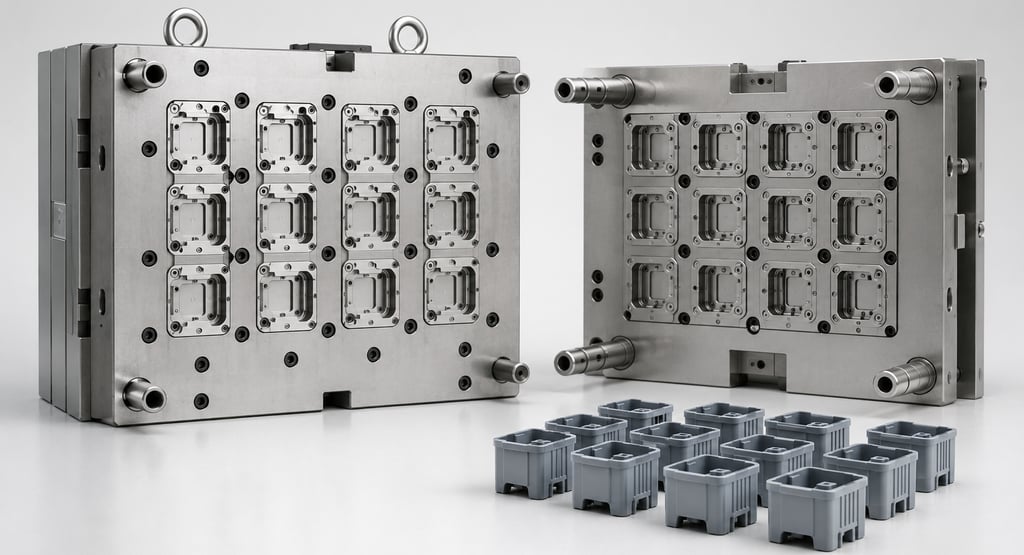
In high-volume production, multi-cavity mold design can be preferred to increase production capacity. Multi-cavity molds allow multiple parts to be produced in each cycle and help reduce unit production cost.
However, multi-cavity mold design requires more careful engineering compared to single-cavity molds. Each cavity must operate under the same pressure, temperature, and filling conditions. Otherwise, differences in part weight, dimensions, surface quality, or filling may occur between cavities.
The key points to consider in multi-cavity molds are:
Balanced runner design
Equal filling between cavities
Balanced cooling
Equal ejector system
Mold rigidity
Ease of maintenance
Suitability for part removal and automation
When a multi-cavity mold is designed correctly, it provides a significant capacity advantage in high-volume production. However, if it is designed incorrectly, it creates the risk of producing multiple defective parts in every cycle.
4. Hot Runner or Cold Runner Decision
In high-volume production, runner system selection directly affects total cost. A cold runner system may be more economical in terms of initial investment cost; however, it creates runner waste in every cycle. In high-volume production, this waste can turn into a serious material loss.
A hot runner system requires a higher initial investment; however, it reduces runner waste, can shorten cycle time, and can provide a production process more suitable for automation.
For this reason, when selecting a runner system for high-volume projects, the decision should not be based only on mold cost, but on total production cost.
The main criteria to evaluate are:
Annual production quantity
Material kilogram price
Runner scrap weight
Part weight
Number of cavities
Cycle time target
Frequency of color changes
Maintenance and failure risk
In high-volume production using expensive materials, hot runner systems can often be more advantageous in the long term.
5. Cooling Design Determines Cycle Time
In plastic injection molding, a significant part of the cycle time is spent on cooling. Therefore, cooling design is a critical subject in high-volume production.
Every area of the part inside the mold should cool evenly. Uneven cooling may cause problems such as warpage, deformation, dimensional deviation, surface waviness, and long cycle times.
In high-volume production, even a few seconds of improvement in cycle time can create a major difference in total production capacity. For example, saving 3 seconds in each cycle can provide a significant time and machine cost advantage in million-part production.
However, cooling time should not only be shortened; it should also be made balanced and controlled. If the part is ejected from the mold before it has cooled sufficiently, deformation or dimensional changes may occur.
Therefore, proper cooling design is a basic requirement for both quality and production efficiency.
6. Ease of Maintenance Should Be Part of the Design
In high-volume production, it is very important that mold maintenance can be carried out easily. No matter how durable the mold is, long-term production creates a need for cleaning, lubrication, part replacement, and mechanical inspection.
In molds designed without considering ease of maintenance, even a small intervention may require the entire mold to be disassembled. This extends production stoppages and increases cost.
For this reason, in high-volume molds, areas exposed to wear should be designed with replaceable insert structures wherever possible. Sliders, moving cores, ejector pins, runner areas, and critical surfaces should be easily accessible during maintenance.
A mold that is easy to maintain means lower downtime, faster intervention, and more stable production in the long term.
7. The Ejector System Must Be Planned Correctly
In high-volume production, the ejector system is one of the most heavily operating mechanisms of the mold. In every cycle, the part is pushed out of the mold, and this movement is repeated millions of times.
Insufficient or incorrectly positioned ejector pins may cause marks, deformation, warpage, or breakage on the part. At the same time, if the ejector system is overloaded, the risk of wear and failure in the mold mechanism increases.
When designing the ejector system, part geometry, wall thickness, demolding resistance, and visual surface expectations should be considered. Ejector marks should not be located on critical visual surfaces.
In high-volume production, the ejector system must be strong, balanced, and easy to maintain.
8. Mold Rigidity and Closing Surfaces
In high-volume production, the mold is continuously exposed to high clamping force and injection pressure. Therefore, the rigidity of the mold body and the durability of the closing surfaces are important.
Insufficient rigidity may cause deformation on mold surfaces or flash problems over time. Especially in large-surface or multi-cavity molds, mold plates must have sufficient strength.
Closing surfaces should be designed correctly and protected against wear. Even a small deformation on the closing surfaces can lead to continuous flash formation in mass production.
For this reason, mold sets, support plates, guide pillar and bushing systems, and closing surfaces should be planned for long-lasting production in high-volume molds.
9. Suitability for Automation
In high-volume production, the use of automation can increase production efficiency. Robotic part removal, conveyor systems, automatic separation, quality control equipment, or packaging solutions can make the production process more controlled.
However, for automation to work efficiently, the mold design must also be suitable for it. The part demolding direction, gripping points, runner separation method, part drop area, and cycle time should be planned in line with automation requirements.
A mold designed without considering automation may require manual intervention in mass production. This increases labor cost and creates quality variation.
10. Standardized Process and Repeatable Quality
In high-volume production, the goal is not only to produce quickly. It is also necessary to achieve the same quality in every cycle. Therefore, mold design should support a stable and repeatable process.
Balanced filling, balanced cooling, correct ejector system, suitable runner structure, and good venting improve process stability.
A high-quality mold for high-volume production should provide the following:
Same part quality in every cycle
Low scrap rate
Stable cycle time
Easy maintenance
Long mold life
Low downtime
Traceable production performance
These criteria help keep total cost under control in high-volume production.
Gri Kalıp’s Approach to High-Volume Production Molds
At Gri Kalıp ve Plastik A.Ş., we evaluate mold design in high-volume plastic injection projects not only according to the success of the first production run, but also according to long-term mass production performance.
Product geometry, material type, production quantity, number of cavities, cycle time target, maintenance requirements, and quality expectations are analyzed together. In mold design, durability, ease of maintenance, balanced cooling, and process stability are prioritized.
In high-volume production, proper mold design means lower unit cost, more reliable delivery, less scrap, and more sustainable quality.
Conclusion
Proper mold design for high-volume production is one of the most important factors determining long-term success in plastic injection molding projects. In molds that will produce millions of shots, not only durability but also ease of maintenance, cycle optimization, correct steel selection, balanced cooling, multi-cavity mold balance, and automation suitability are highly important.
Incorrect design decisions made to reduce the initial investment cost may cause higher costs in mass production. On the other hand, a properly designed mold provides stable production, low scrap rates, and reliable quality for many years.
Successful high-volume production is possible by managing correct product design, proper mold design, and a controlled production process together.
Frequently Asked Questions
What is the most important criterion in mold design for high-volume production?
The most important criteria are mold life, cycle time, ease of maintenance, balanced filling, correct cooling, and process stability. These criteria should be evaluated together.
Does a multi-cavity mold provide advantages in high-volume production?
Yes. Multi-cavity molds increase production capacity by producing more than one part in each cycle and can reduce unit cost. However, balanced filling and cooling design must be done correctly.
Is a hot runner system necessary for high-volume production?
It is not always necessary. However, in high-volume production, multi-cavity molds, or projects using expensive materials, hot runner systems can provide advantages in terms of material savings and cycle time.
Why is ease of mold maintenance important?
In high-volume production, molds work for long periods and require regular maintenance. Molds that are easy to maintain reduce production stoppages and lower long-term costs.
Why is cycle time critical in high-volume production?
Even a few seconds of improvement in cycle time can provide significant time and cost advantages in million-part production. Therefore, cooling, runner, and ejector systems should be optimized according to cycle time.
Which areas wear more in high-volume production molds?
Gate points, runner areas, sliders, moving cores, ejector pins, closing surfaces, and flow areas in contact with glass fiber reinforced materials carry a higher risk of wear.
Site Map
Home | About Us | Capabilities | Projects | Human Resources | Blog | Contact
CONTACT
Subscribe
+90 212 485 41 41
info@grikalip.com.tr
© 2024. All rights reserved.