Quality Control Process in Plastic Injection Molding
High-quality production is achieved not only through final inspections, but also through quality management applied throughout the entire process. In this article, we examine effective quality control methods.
6/29/20267 min read
Quality Control Process in Plastic Injection Molding
Meta Title: Quality Control Process in Plastic Injection Molding | Gri Kalıp
Meta Description: How is the quality control process applied in plastic injection molding? Explore all stages from material inspection and process monitoring to dimensional control and final inspection before shipment.
URL Slug: quality-control-process-in-plastic-injection-molding
Blog Card Short Description: High-quality production is achieved not only through final inspections, but also through quality management applied throughout the entire process. In this article, we examine effective quality control methods in plastic injection molding.
Why Is Quality Control Important in Plastic Injection Molding?
Quality control in plastic injection molding is not limited to checking parts after production is completed. True quality management is a comprehensive process that includes product design, mold manufacturing, material selection, process settings, mass production monitoring, dimensional control, and final inspection before shipment.
For a plastic part to be considered high quality, it is not enough for it to look visually acceptable. The part dimensions must comply with the technical drawing, assembly compatibility must be achieved, functional expectations must be met, surface quality must meet the acceptance criteria, and the same quality standard must be maintained throughout production.
Especially in high-volume mass production, even a small quality deviation can result in thousands of defective parts. Therefore, the quality control process does not begin at the end of production; it begins at the very start of the project.
1. Project and Technical Specification Review
The first step of the quality control process is to correctly understand the technical expectations of the part to be produced. The product technical drawing, 3D data, tolerance values, material information, surface expectations, color standard, assembly requirements, and customer-specific requests must be clarified before production begins.
At this stage, the following points are evaluated:
What are the critical dimensions of the part?
Which tolerances will be checked?
What material and color will be used?
Will the part be assembled with another product?
Are there any special expectations for visible surfaces?
Is a functional test required?
Is there a customer-specific quality specification?
Starting production before this information is clearly defined may cause dimensional errors, incorrect material usage, color differences, or functional nonconformities in later stages.
2. Incoming Material Inspection
In order to produce high-quality parts in plastic injection molding, the material used must be correct and suitable for production conditions. Material inspection is an important part of the quality assurance process before production.
During incoming material inspection, the material type, lot number, color information, technical datasheet information, and quality certificates, if available, should be checked. Especially in engineering plastics, moisture content and drying conditions directly affect quality.
For example, if moisture-sensitive materials such as PA, PC, PBT, and PET are not dried sufficiently, silver streaks, bubbles, loss of mechanical strength, or process instability may occur. Therefore, material preparation before production is one of the key steps in the quality control process.
3. Mold Control
Before starting mass production, it must be checked whether the mold is ready for production. Mold closing surfaces, ejector system, sliders, moving cores, cooling connections, runner system, and venting channels should be inspected.
A small problem in the mold can turn into a major quality issue during production. For example, dirt or wear on the closing surface may cause flash formation. A blocked cooling channel may create warpage and dimensional deviations on the part. A problem in the ejector system may cause marks, deformation, or breakage on the part.
For this reason, mold control is an important stage that should be followed not only by the maintenance team but also by the quality and production teams.
4. First Article Inspection
When production begins, the first parts produced should be checked in detail. This stage is generally called first article inspection or first part approval.
In first article inspection, the part is examined both visually and dimensionally. Critical dimensions are checked according to the technical drawing, surface quality is evaluated, and the part is inspected for flash, sink marks, burn marks, short shots, weld lines, or deformation.
Mass production should not continue before first article approval is obtained. A defect that is not detected at the beginning can lead to a large amount of scrap as production continues.
The main criteria checked during first article inspection are:
Are the part dimensions in accordance with the technical drawing?
Is there any flash or incomplete filling?
Is the surface quality acceptable?
Do the color and appearance meet customer expectations?
Does the part come out of the mold properly?
If assembly or functional testing is required, is the result acceptable?
5. Process Parameter Monitoring
In plastic injection molding, quality is directly related to process parameters. Values such as injection pressure, injection speed, holding pressure, holding time, mold temperature, material temperature, and cooling time must be kept under control throughout production.
Even if the same mold and the same material are used, changes in process settings can affect part quality. For example, if holding pressure decreases, sink marks may occur. If injection pressure increases too much, flash may appear. If mold temperature is unstable, warpage or dimensional changes may be observed.
Therefore, approved process parameters should be recorded and monitored throughout production to ensure that there are no deviations from these values.
6. Periodic Inspection During Production
Quality control should not be performed only at the beginning of production. While mass production continues, samples should be taken at defined intervals and parts should be inspected.
During these inspections, part dimensions, weight, visual quality, color consistency, flash condition, surface defects, and functional features are evaluated. The inspection frequency is determined according to the sensitivity of the product, production quantity, customer expectations, and application area of the part.
Periodic inspection is especially important in automotive, electrical and electronics, home appliance, and technical plastic part production. The earlier a quality problem is detected, the lower the scrap and cost will be.
7. Dimensional Control
Dimensional accuracy of plastic parts is critical for the functional success of the product. If the part will be assembled with another product or has tight tolerances, dimensional control becomes even more important.
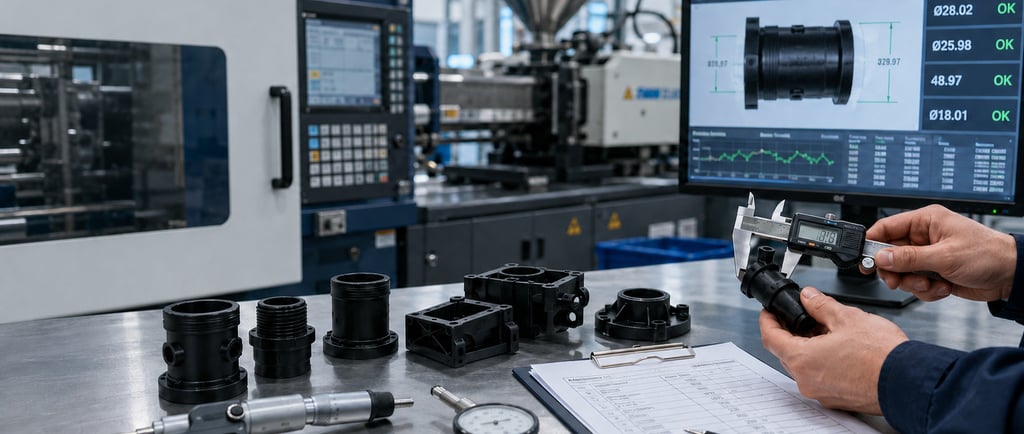
In dimensional control, calipers, micrometers, gauges, dial indicators, special control fixtures, or coordinate measuring machines can be used. The measurement equipment to be used is determined according to the sensitivity of the part and the tolerances specified in the technical drawing.
In dimensional control, not only general dimensions but also critical functional areas should be checked. Screw bosses, clips, fitting surfaces, mounting holes, wall thicknesses, and connection points should be inspected regularly.
8. Visual Control
Visual quality is highly important in plastic injection parts, especially in products visible to the end user. During visual control, the part surface, color consistency, and production defects are examined.
The most commonly checked defects in visual control are:
Flash
Sink marks
Burn marks
Weld lines
Short shots
Color differences
Black spots
Gloss differences
Scratches or dents
Deformation
Ejector marks
Visual quality criteria must be clearly defined before production. Otherwise, quality evaluation becomes open to personal interpretation. Defining acceptable and unacceptable samples helps operators and the quality team work according to the same standard.
9. Functional Control
For some plastic parts, dimensional and visual control alone is not sufficient. It must also be tested whether the part performs its function under real usage conditions.
Functional control may include assembly tests, fitting tests, leak tests, locking tests, flexibility tests, strength tests, or moving mechanism checks.
For example, in a plastic part with a clip feature, it is not enough for the dimensions to be correct. The clip must flex without breaking, fit into place, and perform its function. Similarly, assembly compatibility may be critical for covers, boxes, housings, or connection components.
10. Records and Traceability
All checks performed during the quality control process should be recorded. Measurement results, control forms, material lot information, production dates, machine information, and operator records should be traceable.
Traceability is especially important in the case of a customer complaint or field problem. Information such as which material lot was used in which production batch, which machine was used, which process values were applied, and which quality checks were performed can be tracked through the recording system.
A quality control process that is not recorded is not sustainable. For effective quality management, a measurable, traceable, and reportable system must be established.
11. Final Inspection Before Shipment
After production is completed, parts should be checked again before shipment. At this stage, it is verified that the products are packaged correctly, label information is accurate, there is no mixing, and customer shipment requirements are met.
Final inspection before shipment is the last safety step that prevents defective or incomplete products from reaching the customer. Special attention should be paid to the risk of mixing, especially in production involving different colors, different models, or similar parts.
Packaging quality should also be evaluated at this stage. A correctly produced part may still be scratched, crushed, or deformed due to incorrect packaging or transportation.
Gri Kalıp’s Quality Control Approach
At Gri Kalıp ve Plastik A.Ş., we consider quality in plastic injection molding not only as final product inspection, but as a management system applied throughout the entire production process.
From product design and mold manufacturing to material selection, process control, dimensional inspections, and final inspection before shipment, we aim to ensure quality at every stage.
Our experienced team aims to detect quality risks at an early stage during production, reduce scrap rates, maintain production continuity, and provide reliable plastic part production to our customers.
Conclusion
The quality control process in plastic injection molding is one of the key elements of high-quality and sustainable production. Successful quality management is achieved not only through final inspections, but through the combined management of all stages, from incoming material inspection and mold control to first article approval, process monitoring, dimensional control, and final inspection before shipment.
A proper quality control system reduces scrap rates, increases customer satisfaction, keeps production costs under control, and ensures that the quality standard is maintained in mass production.
In plastic injection molding, quality is not a result achieved by chance; it is a process that is planned, measured, and continuously improved.
Frequently Asked Questions
How is quality control performed in plastic injection molding?
Quality control is performed through material inspection, mold control, first article approval, process parameter monitoring, dimensional control, visual control, functional testing, and final inspection before shipment.
Why is first article inspection important?
First article inspection verifies whether the part complies with the technical drawing, surface expectations, and functional requirements before mass production begins. This stage helps detect defective production at an early stage.
Which equipment is used in dimensional control?
Depending on the sensitivity of the part, calipers, micrometers, gauges, dial indicators, special control fixtures, or coordinate measuring machines can be used.
Which defects are examined in visual control?
Surface problems such as flash, sink marks, burn marks, weld lines, short shots, color differences, black spots, scratches, deformation, and ejector marks are evaluated during visual control.
Why should process parameters be recorded?
Recording process parameters ensures that production can be repeated at the same quality standard. It also helps perform root cause analysis in case of defects.
Why is traceability important?
Traceability makes it possible to track which material lot, date, machine, and production conditions were used for a specific part. This is important for quality management and customer confidence.
Site Map
Home | About Us | Capabilities | Projects | Human Resources | Blog | Contact
CONTACT
Subscribe
+90 212 485 41 41
info@grikalip.com.tr
© 2024. All rights reserved.