The Importance of Maintenance in Plastic Injection Molds
Molds that are not maintained regularly may cause production losses and high costs. Preventive maintenance practices extend mold life while also improving production continuity.
6/29/20267 min read
The Importance of Maintenance in Plastic Injection Molds
Meta Title: The Importance of Maintenance in Plastic Injection Molds | Gri Kalıp
Meta Description: Why is regular maintenance important in plastic injection molds? Explore the key points for extending mold life, reducing production losses, and maintaining mass production quality.
URL Slug: the-importance-of-maintenance-in-plastic-injection-molds
Blog Card Short Description: Plastic injection molds that are not maintained regularly may cause production losses, quality problems, and high costs. Preventive maintenance practices extend mold life while also improving production continuity.
Why Is Maintenance Important in Plastic Injection Molds?
Plastic injection molds are among the most valuable and critical equipment in mass production. A mold is not simply a production tool made of metal components; it is a precise engineering system that directly determines product quality, cycle time, dimensional accuracy, and production efficiency.
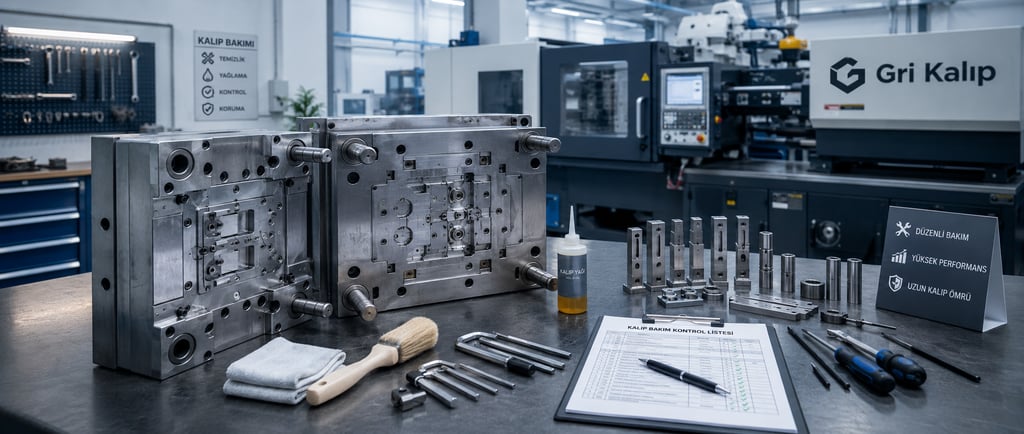
For this reason, maintenance in plastic injection molds is essential for production continuity. In molds that are not maintained regularly, problems such as wear, contamination, lack of lubrication, clogged cooling channels, ejector system issues, flash formation, and demolding problems may occur over time. These problems not only reduce mold performance but may also lead to production stoppages, increased scrap rates, and customer dissatisfaction.
The right maintenance approach is not to intervene after the mold breaks down, but to perform the necessary checks before a failure occurs in order to protect production continuity. Therefore, preventive maintenance is an important practice that reduces costs and makes quality sustainable in plastic injection molding.
What Problems Occur in Molds Without Maintenance?
Plastic injection molds are exposed to high pressure, temperature, mechanical movement, and continuous opening-closing cycles during production. These intense working conditions may cause wear on the mold over time.
One of the most common problems in molds without maintenance is flash formation. If there is wear or dirt accumulation on the mold closing surfaces, plastic material may leak through the parting line. This creates flash on the edges of the part and requires additional cleaning labor.
Another common problem is difficulty in part ejection. If ejector pins, sliders, or moving mechanisms are not cleaned and lubricated properly, the part may become difficult to remove from the mold. This may leave marks on the part, cause deformation, or lead to jamming inside the mold.
Clogged cooling channels are also a serious maintenance issue. If lime scale, sediment, or dirt accumulates in the water channels inside the mold, cooling efficiency decreases. Uneven cooling may cause warpage, deformation, dimensional deviations, and longer cycle times.
What Is Preventive Maintenance?
Preventive maintenance refers to inspection, cleaning, lubrication, and renewal operations carried out at specific intervals before the mold fails. The aim is to prevent unexpected stoppages during production and maintain mold performance for a long time.
With preventive maintenance, small problems on the mold can be detected before they become major issues. For example, if a loose connection element, a slider that has started to wear, a cooling channel beginning to clog, or a dirty venting channel is noticed in time, major production losses can be prevented.
This approach provides a significant advantage especially for companies carrying out high-volume mass production. Planned maintenance can be completed with a short stoppage, while an unplanned failure may stop production completely and negatively affect delivery times.
Main Areas to Check During Mold Maintenance
When maintaining plastic injection molds, cleaning only the visible surfaces is not enough. All critical areas that affect mold production performance should be checked regularly.
1. Mold Closing Surfaces
Mold closing surfaces are very important for preventing flash formation. If there is dirt, plastic residue, crushing, or wear on these surfaces, the mold may not close properly. This may lead to flash, dimensional deviations, and surface defects in production.
During maintenance, closing surfaces should be cleaned, checked for damage, and precision fitting should be carried out if necessary.
2. Ejector System
Ejector pins, ejector plates, and return mechanisms allow the part to be removed from the mold properly. If there is contamination, dry operation, or mechanical jamming in this system, ejector marks, breakage, or deformation may occur on the part.
The ejector system should be cleaned regularly, movement should be checked, and proper lubrication should be applied. Worn pins or damaged components should be replaced in time.
3. Sliders and Moving Cores
Sliders and moving cores are movable mold components used in the production of plastic parts with complex geometries. Since these areas are exposed to high friction, they are considered critical for maintenance.
If there is clearance, jamming, or insufficient lubrication in the sliders, mold movements become difficult. This may damage both the mold and the produced part. During maintenance, slider paths should be cleaned, wear should be checked, and proper lubrication should be applied.
4. Venting Channels
The air inside the mold must be able to escape during plastic material filling. When venting channels are clogged, burn marks, short shots, weld lines, or surface problems may occur.
For this reason, venting channels should be cleaned regularly and cleared of plastic residues. Especially in high-volume production, clogged venting channels can quickly lead to quality problems.
5. Cooling Channels
The cooling system has a direct effect on cycle time and part quality. Over time, lime scale, rust, sediment, or dirt may accumulate in the water channels inside the mold. These deposits reduce water flow and prevent the mold from cooling evenly.
Cooling channels should be checked regularly, water flow should be tested, and cleaning should be carried out if necessary. Balanced cooling is one of the basic requirements for producing high-quality and dimensionally stable plastic parts.
6. Runner and Gate Areas
Runner, nozzle, and gate areas ensure that plastic material is transferred correctly into the mold. If material residue, wear, or clogging occurs in these areas, filling problems may be observed.
During maintenance, runner systems should be cleaned, gate points should be checked, and any issue that may prevent material flow should be examined.
How Should Maintenance Frequency Be Determined?
Mold maintenance frequency is not the same for every mold. The maintenance period should be determined according to the mold’s production quantity, the material used, product geometry, mold structure, and production conditions.
A simple mold and a mold with sliders, moving cores, or a hot runner system may not have the same maintenance requirements. Similarly, molds working with glass fiber reinforced or abrasive materials may require more frequent maintenance.
When creating a maintenance plan, the number of shots should be tracked and inspections should be carried out after defined production quantities. For example, a quick check before production, visual monitoring during production, cleaning after production, and detailed maintenance after certain shot counts can be applied.
The important point is that maintenance should not be random; it should be recorded and planned.
The Importance of Mold Maintenance Records
Mold maintenance records are very important in professional production systems. Information such as when maintenance was performed on which mold, which parts were replaced, which problems were observed, and which checks were carried out after maintenance should be recorded.
Thanks to these records, the past performance of the mold can be monitored. It can be seen whether the same failure repeats. Areas that wear more frequently can be analyzed. Maintenance records also create a strong data source for planned production and quality management.
Maintenance activities that are not recorded do not create a sustainable system in the long term. For high-quality mass production, mold maintenance should be measurable and traceable.
Advantages of Regular Maintenance for Production
Regular mold maintenance is necessary not only to prevent failures but also to improve production performance. Well-maintained molds operate more stably, part quality becomes more consistent, and unexpected stoppages during production are reduced.
The main advantages of regular maintenance are:
It extends mold life.
It reduces flash, burn marks, and part ejection problems.
It helps prevent production stoppages.
It reduces scrap rates.
It helps keep cycle time stable.
It improves quality continuity.
It reduces maintenance and revision costs in the long term.
It supports delivery reliability.
These advantages provide significant cost and time savings, especially for companies carrying out high-volume production.
Gri Kalıp’s Approach to Mold Maintenance
At Gri Kalıp ve Plastik A.Ş., we consider the maintenance process in plastic injection molds as an integral part of production. From mold manufacturing to mass production, we aim for molds to operate with long life, stability, and efficiency at every stage.
In mold maintenance, cleaning, lubrication, mechanical inspection, cooling system control, checking of moving mechanisms, and production performance monitoring should be handled together. With this approach, the goal is not only for molds to operate, but also to produce at the same quality standard for a long period of time.
Regular maintenance is one of the basic requirements for high-quality plastic part production. A well-maintained mold provides reliability, quality, and efficiency in production.
Conclusion
Maintenance in plastic injection molds is a critical subject for production continuity and quality management. Molds that are not maintained regularly may cause flash, part ejection problems, dimensional deviations, inefficient cooling, and production stoppages over time.
Preventive maintenance practices extend mold life, reduce production losses, and provide sustainable quality in mass production. Therefore, mold maintenance is not only a technical operation; it is a strategic process that directly affects production costs and customer satisfaction.
With the right maintenance plan, recorded tracking system, and regular inspections, plastic injection molds can be used efficiently for many years.
Frequently Asked Questions
How often should plastic injection mold maintenance be performed?
Maintenance frequency depends on the mold structure, production quantity, material used, and working conditions. In high-volume production, a periodic maintenance plan should be created based on the number of shots.
What happens if mold maintenance is not performed?
If mold maintenance is not performed, flash formation, part ejection problems, surface defects, dimensional deviations, cooling problems, and production stoppages may occur. This increases costs and reduces quality.
What are the most important control points in mold maintenance?
Mold closing surfaces, ejector system, sliders, moving cores, venting channels, cooling channels, and runner areas should be checked regularly.
Why should cooling channels be cleaned?
If lime scale, sediment, or dirt accumulates in cooling channels, the mold cannot cool evenly. This may extend cycle time and cause warpage, deformation, or dimensional deviations on the part.
Why are mold maintenance records important?
Maintenance records allow the past performance of the mold to be monitored. Repeated failures, replaced parts, and maintenance dates can be tracked through these records.
Does regular maintenance extend mold life?
Yes. Regular cleaning, lubrication, and inspection reduce wear on the mold, ensure healthy operation of mechanical systems, and help the mold be used efficiently for a long time.
Site Map
Home | About Us | Capabilities | Projects | Human Resources | Blog | Contact
CONTACT
Subscribe
+90 212 485 41 41
info@grikalip.com.tr
© 2024. All rights reserved.