What You Should Know Before Ordering a Plastic Injection Mold
For a successful project, we cover the key points to consider, from technical drawings and tolerances to material selection and production quantities.
6/29/202610 min read
What You Should Know Before Ordering a Plastic Injection Mold
Meta Title: What You Should Know Before Ordering a Plastic Injection Mold | Gri Kalıp
Meta Description: Before ordering a plastic injection mold, technical drawings, material selection, tolerances, production volume, number of mold cavities, and the technical guidance of the mold manufacturer should be evaluated correctly.
URL Slug: what-you-should-know-before-ordering-a-plastic-injection-mold
Blog Card Short Description: For a successful plastic injection mold project, many details should be clarified before ordering, from technical drawings and tolerances to material selection and production quantities. A successful project is achieved by evaluating customer expectations together with the mold manufacturer’s technical knowledge and production capability.
Why Is Ordering a Plastic Injection Mold a Technical Process?
Ordering a plastic injection mold is not simply a process of receiving a price quotation and starting production. A successful mold project requires product design, material selection, tolerance expectations, production volume, mold structure, steel selection, runner system, cooling design, and mass production targets to be evaluated together.
A plastic injection mold is an important investment made for long-term production. Decisions made at the ordering stage directly affect not only mold cost, but also product quality, production speed, scrap rate, maintenance requirements, and mold life.
For this reason, before ordering a mold, the project should be prepared correctly from a technical perspective, and customer expectations should be evaluated together with the technical experience of the manufacturer. In mold manufacturing, the best results are achieved through mutual information sharing and correct engineering guidance.
1. Product Data and Technical Drawings Should Be Ready
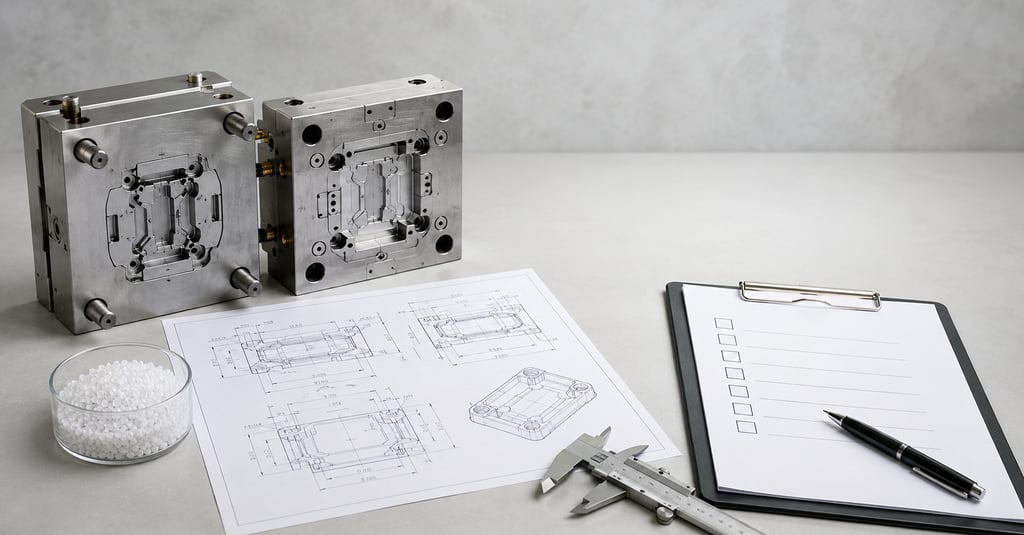
When ordering a plastic injection mold, the first requirement is accurate and up-to-date product data for the part to be manufactured. The 3D model, technical drawing, critical dimensions, tolerances, and assembly relationships, if any, should be shared with the mold manufacturer.
In some cases, it may be possible to request a mold price based only on a visual image or sample. However, technical data is required for a proper project evaluation. It should be clearly known which dimensions are critical, which surfaces are visible, and whether the part will be assembled with another product.
The clearer the technical drawing and 3D data are, the more accurate the mold design and pricing process will be. Missing or unclear product information may lead to revision requirements after mold manufacturing is completed.
2. The Plastic Material to Be Used Should Be Determined
The plastic material to be used must be considered during mold design. This is because each material has different shrinkage rates, flow behavior, temperature characteristics, mechanical strength, and molding conditions.
PP, ABS, PC, PA, POM, PE, and glass fiber reinforced engineering plastics do not behave in the same way in the mold. When the material changes, part dimensions, surface quality, filling behavior, and mold shrinkage allowance may also change.
Before ordering a mold, the following questions should be clarified:
In which environment will the product be used?
Is impact resistance required?
Will it be exposed to heat?
Should it be flexible or rigid?
Will there be chemical contact?
Is visual surface quality important?
Is there a need for food contact, medical, or special standards?
Mold designs created before material selection is finalized may lead to dimensional and production problems at later stages. Therefore, correct material selection is one of the key inputs of mold design.
3. Production Volume Should Be Defined Correctly
The number of parts to be produced directly affects mold design and mold cost. A mold designed for low-volume production and a mold expected to produce millions of shots are not planned at the same technical level.
Production volume determines steel selection, number of cavities, hot runner or cold runner decision, maintenance structure, and mold life expectations.
For low-volume projects, more economical solutions may be preferred. For high-volume projects, more durable steels, better cooling systems, ease of maintenance, and cycle optimization become more important.
Therefore, before ordering a mold, not only the first production quantity but also annual and long-term production targets should be shared. This allows the mold to be designed at the right level according to the real production requirement.
4. Tolerance Expectations Should Be Clear
Tolerance expectations for plastic parts are a critical issue in mold manufacturing. Requesting very tight tolerances for every plastic part may not always be technically or economically correct. The shrinkage behavior of the plastic material, moisture absorption, part geometry, and process conditions all affect tolerances.
Especially in assembled parts, screw bosses, clips, fitting surfaces, and functional areas, critical dimensions should be identified. Requesting unnecessarily tight tolerances in non-critical areas can increase mold cost and make production more difficult.
The correct approach is to define the dimensions that are truly critical for the product’s function and optimize the mold design according to these dimensions. This protects quality expectations while avoiding unnecessary costs.
5. The Mold Manufacturer’s Technical Guidance Should Be Considered
When ordering a plastic injection mold, the technical guidance of the mold manufacturer should be considered as much as the customer’s expectations. A successful project is achieved when customer requirements are evaluated together with the manufacturer’s capacity, experience, and technical know-how.
The customer is the party that best knows the product’s intended use, visual expectations, target cost, and production needs. The mold manufacturer technically evaluates how these requirements can be achieved in plastic injection molding, which details may create risks, and which design changes can make production more efficient.
For this reason, proceeding with one-sided decisions in mold projects often does not produce healthy results. Designs made only according to customer requests without considering manufacturability may lead to high revision costs, inefficient production, long cycle times, or short mold life.
Likewise, it is not correct for the manufacturer to provide guidance only based on ease of production without understanding the product function and market expectations. In successful mold projects, the best result is achieved through mutual technical evaluation.
Product requirements, mold manufacturing capability, cost targets, and mass production efficiency should be considered together.
6. Product Design Should Be Reviewed for Manufacturability
Before starting mold manufacturing, the product design should be analyzed in terms of manufacturability. Wall thicknesses, draft angles, undercuts, rib structures, screw bosses, clip details, and sharp corners should be reviewed carefully.
A small improvement during the design stage can prevent a major revision after mold manufacturing.
For example, a surface with insufficient draft angle may create problems during demolding. A screw boss that is too thick may cause sink marks on the outer surface. Unnecessary undercuts may require sliders or moving cores in the mold, increasing cost.
Therefore, the mold manufacturer’s technical feedback during the design stage is important for the health of the project. A proper manufacturability analysis reduces both mold cost and mass production risks.
7. Hot Runner or Cold Runner Decision Should Be Made
Before ordering a mold, the runner system should also be evaluated. A cold runner system may offer a lower initial investment cost; however, it creates runner waste during production. A hot runner system may have a higher initial cost, but it can reduce scrap and contribute to cycle time in high-volume production.
When making this decision, not only mold cost but also long-term production cost should be considered. Production volume, material price, part weight, runner scrap amount, cycle time, and maintenance requirements should be calculated together.
In some projects, a hot runner system may be the right long-term investment, while in others, a cold runner system may be a more practical and economical solution. The right choice should be made according to the technical structure of the product and the production targets.
8. The Number of Mold Cavities Should Be Planned Correctly
The number of mold cavities determines how many parts will be produced in each cycle. At first glance, molds with a high number of cavities may seem more advantageous because more parts are produced in each shot. However, this decision may not be correct for every project.
High-cavity molds can provide advantages in certain high-volume production projects. Especially if the product geometry is simple, material flow is balanced, quality expectations are standard, and production volume is very high, a multi-cavity mold can reduce unit part cost.
However, in many projects, a high number of cavities brings certain risks. Mold cost increases, mold design becomes more complex, manufacturing time becomes longer, and achieving the same quality in all cavities becomes more difficult. Differences in filling, cooling, dimensions, or part weight may occur between cavities. This may increase production risk, especially in parts with tight tolerances or high visual quality expectations.
In addition, multi-cavity molds generally require larger injection molding machines. Using a larger machine may increase machine hourly cost and energy consumption. On the other hand, a mold with fewer cavities can operate on smaller-tonnage machines and provide a more controlled plastic injection molding process.
Therefore, when determining the number of mold cavities, the goal should not only be to produce more parts per cycle. Production volume, part geometry, material type, quality expectations, machine park, cycle time, and total production cost should be evaluated together.
The correct number of cavities is not always the highest number of cavities. The correct number of cavities is the one that provides the best balance between quality, cost, production speed, and process safety.
9. Surface Quality and Visual Expectations Should Be Shared
The visible surfaces, texture expectations, gloss level, color standard, and surface sensitivity of the plastic part affect the mold manufacturing process.
Expectations such as glossy surface, matte surface, textured surface, polishing, sandblasting, or special patterns directly affect mold design and mold surface treatments. Therefore, visual expectations should be clarified before ordering.
Especially in products visible to the end user, surface quality is important not only for aesthetics but also for brand perception. When the mold manufacturer knows these expectations, the correct steel selection and surface processing decisions can be made.
10. Trial Production and Revision Process Should Be Planned
After the plastic injection mold is manufactured, the first trial production is carried out. At this stage, part filling, dimensions, surface quality, demolding behavior, and process behavior are checked.
After the first trial, some minor revision needs may appear. This is a natural part of the mold manufacturing process. The important point is that revisions should be carried out in a measurable, technical, and controlled manner.
Before ordering the mold, trial production, sample approval, measurement report, revision scope, and transition to mass production should be clearly discussed.
When this process is clearly planned, both the customer and the manufacturer can manage project tracking more effectively.
11. The Decision Should Not Be Based Only on Price
A plastic injection mold is an important investment. Therefore, choosing only the lowest price when ordering a mold may not produce the right result in the long term.
A low-cost mold may create higher costs in mass production due to short mold life, long cycle time, high scrap rate, frequent maintenance requirements, or dimensional problems.
When evaluating mold price, the following points should be considered together:
Which steel will the mold be manufactured from?
What will the production volume be?
How many cavities will the mold have?
Is the number of cavities really suitable for the project?
Has ease of maintenance been considered?
Is the cooling system sufficient?
Has the runner system been selected correctly?
Does the manufacturer have experience in similar projects?
How will the revision and trial process be managed?
The correct mold choice should be evaluated not only by purchase cost, but also by total production efficiency.
12. Machine Park and Production Capacity Should Be Evaluated
When ordering a mold, the manufacturer’s machine park and production capacity should also be considered. Not every mold can operate efficiently on every machine.
Mold size, injection volume, clamping force, part weight, number of cavities, and cycle time affect machine selection. An unnecessarily large mold may require a larger machine, which can increase production cost.
In some cases, a mold with fewer cavities that can operate on a smaller machine may provide a more controlled and economical production process. Therefore, when designing the mold, not only theoretical production quantity but also the manufacturer’s real machine park and process management capability should be considered.
Gri Kalıp’s Approach to the Mold Ordering Process
At Gri Kalıp ve Plastik A.Ş., we aim to provide the most suitable solution by evaluating our customers’ requirements in terms of technical manufacturability in plastic injection mold projects.
Product data, material selection, production volume, tolerances, surface expectations, number of mold cavities, machine suitability, and cost targets are analyzed together. When necessary, we provide our customers with technical recommendations on design improvement, material selection, mold structure, runner system, number of cavities, and production efficiency.
Our goal is not only to manufacture a mold, but also to create the right mold solution that provides high-quality, efficient, long-lasting, and sustainable results in mass production.
A successful mold project is achieved when customer expectations and the technical experience of the manufacturer are combined correctly.
Conclusion
Before ordering a plastic injection mold, many details should be clarified, including technical drawings, 3D data, material selection, production volume, tolerance expectations, surface quality, number of mold cavities, runner system, and the technical capacity of the manufacturer.
For a successful project, customer expectations and the mold manufacturer’s technical guidance should be evaluated together. Proceeding with one-sided demands may increase project cost, reduce production efficiency, and negatively affect mold life.
A high number of cavities is not always the right solution. In some projects, molds with fewer cavities that operate on smaller machines and provide more controlled production may deliver healthier results.
The right mold project is achieved through mutual communication, technical analysis, and an engineering approach focused on manufacturability.
Frequently Asked Questions
What information should be prepared before ordering a plastic injection mold?
3D product data, technical drawings, material information, production volume, tolerance expectations, surface quality, and assembly conditions, if any, should be prepared.
Why are the mold manufacturer’s technical recommendations important?
The mold manufacturer technically evaluates the product’s suitability for plastic injection molding. These recommendations can directly affect mold cost, production efficiency, and mold life.
Should material selection be finalized before ordering a mold?
Yes. Each plastic material has different shrinkage, flow behavior, and production characteristics. A material change can affect mold dimensions and production performance.
Why is mold cost not determined only by part size?
Mold cost is determined by many factors, including product geometry, steel selection, number of cavities, runner system, surface expectations, moving mechanisms, and production volume.
Is a multi-cavity mold always advantageous?
No. Multi-cavity molds can provide advantages for high-volume products with suitable geometry, but they are not the right solution for every project. A high number of cavities may increase mold cost, extend manufacturing time, require a larger machine, and increase the risk of quality differences between cavities. In some projects, a mold with fewer cavities can provide more controlled and more stable production on a smaller machine.
When can a mold with fewer cavities be advantageous?
A mold with fewer cavities may be advantageous if the part has tight tolerances, high visual quality expectations, difficult material flow, or if more controlled production on a smaller machine is targeted. This decision should be made by evaluating production volume, quality expectations, and total cost together.
Should only the lowest price be preferred when ordering a mold?
No. The lowest price may not always be the most advantageous option. Mold life, maintenance requirements, cycle time, scrap rate, number of cavities, and mass production performance should be evaluated together.
Site Map
Home | About Us | Capabilities | Projects | Human Resources | Blog | Contact
CONTACT
Subscribe
+90 212 485 41 41
info@grikalip.com.tr
© 2024. All rights reserved.