
Why Is Plastic Material Selection So Important?
PP, ABS, PC, PA, POM, PET… Each plastic material has different mechanical strength, temperature resistance, and application areas. Choosing the right material directly affects the product’s service life and cost.
6/29/20267 min read
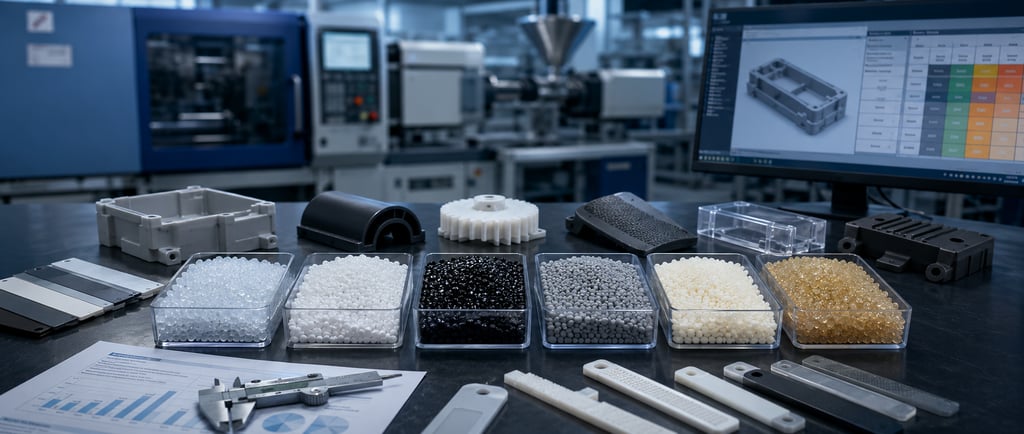
Why Is Plastic Material Selection So Important?
Meta Title: Why Is Plastic Material Selection Important? | Gri Kalıp
Meta Description: Explore the properties, application areas, and impact of plastic materials such as PP, ABS, PC, PA, POM, and PET on product quality and cost.
URL Slug: why-is-plastic-material-selection-important
Blog Card Short Description: PP, ABS, PC, PA, POM, or PET… Each plastic material has different mechanical strength, temperature resistance, and application areas. Choosing the right material directly affects the product’s service life, production quality, and total cost.
Why Is Plastic Material Selection a Critical Decision?
In plastic injection molding, a good mold or a modern injection molding machine alone is not enough to achieve a successful result. One of the most important factors that determines the real performance of a product is choosing the right plastic material. This is because not every plastic material offers the same strength, flexibility, temperature resistance, or surface quality.
When the right material is selected for a product, the part meets expectations both functionally and economically. When the wrong material is selected, many problems may occur, such as cracking, warpage, dimensional deviation, surface deterioration, loss of impact resistance, color problems, or assembly incompatibility.
Plastic material selection is not only a technical decision. It is also a strategic decision that directly affects cost, quality, production efficiency, mold design, cycle time, and product life.
Not Every Plastic Material Is the Same
Plastic materials may look similar from the outside; however, their technical properties can be very different. Some plastics are highly resistant to impact, while others offer better resistance to high temperatures. Some are strong against chemicals, while others stand out with their aesthetic surface quality.
For example, if a plastic part will be used outdoors, it must be resistant to factors such as sunlight, temperature changes, and humidity. In a part used in the electrical and electronics industry, flame retardancy, insulation, and dimensional stability may become more important. In the automotive industry, impact resistance, temperature resistance, and long-term performance are more critical.
For this reason, when selecting plastic material, the question should not only be “Which material is cheaper?” The main point is to determine the material that best suits the product’s operating conditions.
Main Criteria Affecting Plastic Material Selection
When selecting the right material, where, how, and under which conditions the product will be used must be analyzed in detail. A material selected without this analysis may cause problems during production or after the product is put into use.
Mechanical Strength
The load the product will carry, whether it will be exposed to impact, and whether it should be flexible or rigid are determining factors in material selection. For example, flexibility may be important in a clip-type part, while rigidity and strength may be more important in a load-bearing technical part.
Temperature Resistance
Some plastic parts are used at room temperature, while others are exposed to more demanding temperature conditions, such as engine compartments, electrical devices, or outdoor environments. In such cases, the selected material must be suitable for the product’s operating temperature.
Chemical Resistance
Chemical resistance is very important in parts that come into contact with cleaning agents, oils, fuels, cosmetic products, or industrial chemicals. Incorrect material selection may cause cracking, swelling, or surface deterioration over time.
Surface Quality
In visually important products, gloss, color consistency, texture quality, and scratch resistance become important. Especially in cosmetic display products, home appliance parts, and consumer products, aesthetic appearance is an important criterion in material selection.
Dimensional Stability
Some plastic parts are assembled precisely with other components. In such products, shrinkage rate, moisture absorption tendency, and behavior under temperature changes should be considered. A material with poor dimensional stability may cause assembly problems.
Cost and Production Efficiency
The most expensive material is not always the right choice. Likewise, the cheapest material may not be economical in the long term. The right material is the one that meets the technical requirements of the product and optimizes the total cost.
Commonly Used Plastic Materials
Many different materials are used in plastic injection molding. Each material has its own advantages, limitations, and suitable application areas.
PP - Polypropylene
PP is one of the most commonly used materials in the plastic injection molding industry. It is lightweight, economical, has good chemical resistance, and is easy to process. Thanks to its flexible structure, it can be preferred for lids, boxes, packaging parts, household products, and certain technical parts.
The advantage of PP is that it is cost-effective and versatile. However, it may not always be the best option for applications requiring high temperature resistance, high impact resistance, or very precise dimensional expectations. For products used outdoors, UV additives or suitable stabilization may be required.
ABS - Acrylonitrile Butadiene Styrene
ABS is one of the engineering plastics known for its impact resistance and surface quality. It is a rigid, tough, and easily processable material. It is frequently used in electronic housings, automotive interior parts, consumer products, toys, and plastic parts requiring an aesthetic appearance.
ABS provides an advantage in products with visual quality expectations because of its paintable and coat-able surface structure. However, material selection should be carefully evaluated for outdoor use and high-temperature conditions.
PC - Polycarbonate
PC is a technical plastic known for its high impact resistance and transparency. It is a strong, durable, and high-quality material. It can be used in transparent covers, lighting parts, safety equipment, technical housings, and products requiring high strength.
Process control is important in PC material selection. Drying conditions, mold temperature, and injection parameters must be managed correctly. Otherwise, surface problems, internal stress, or brittleness may occur.
PA - Polyamide
PA is an engineering plastic preferred in applications requiring high mechanical strength, wear resistance, and technical performance. It can be used in gears, technical connection parts, automotive components, machine parts, and products requiring durability.
One of the important characteristics of PA is its tendency to absorb moisture. This may affect the dimensional behavior and mechanical properties of the part. Therefore, drying conditions and the usage environment must be carefully evaluated in projects using PA.
POM - Polyoxymethylene
POM stands out with its low friction coefficient, good dimensional stability, and high wear resistance. It is frequently preferred in gears, sliding parts, precision mechanical components, moving parts, and connection elements.
POM is a material with high technical performance; however, it is not suitable for every product. Detailed evaluation should be made especially in applications involving chemical contact, high temperature, or special safety requirements.
PET - Polyethylene Terephthalate
PET is a plastic material that offers good mechanical properties, surface quality, and high performance in certain applications. Although it is widely known in the packaging industry, it can also be used in engineering applications. Glass fiber reinforced PET grades may be preferred for technical parts.
Drying and process control are important when using PET. Moisture can cause quality problems during processing. Therefore, raw material preparation before production must be carried out correctly.
How Does Material Selection Affect Mold Design?
Plastic material selection directly affects not only the part to be produced but also the mold design. Each material has different flow behavior, shrinkage rate, demolding behavior, and cooling characteristics.
For example, mold dimensions must be designed according to the shrinkage rate of a material with high shrinkage. In glass fiber reinforced materials, mold steel and surface treatments must be selected carefully because the risk of wear is higher. In materials with low flowability, gate location, runner system, and part wall thickness become more critical.
For this reason, finalizing the material information before starting mold design provides a major advantage. If the material is changed after the mold is manufactured, dimensional, surface, filling, or warpage problems may occur.
Consequences of Incorrect Material Selection
Incorrect plastic material selection may cause serious problems even after production is completed. A part that appears suitable at first glance may crack, bend, deform, or fail to withstand environmental conditions during use.
For example, a material without sufficient impact resistance may break during field use. A material with low temperature resistance may lose its form when exposed to heat. A material with insufficient chemical resistance may experience surface deterioration when it comes into contact with cleaning agents or oils.
Such problems not only increase part cost. They may also lead to customer complaints, return processes, loss of brand trust, and new mold revisions.
How Does the Right Material Selection Affect Cost?
Material selection plays an important role in the unit cost of the product. However, cost evaluation should not be made only according to the kilogram price. Material density, cycle time, scrap rate, drying requirement, process stability, and product life also affect the total cost.
In some cases, a cheaper material may appear advantageous in the short term, but it can become more expensive in the long term due to high scrap rates, low durability, or customer complaints. In other cases, an expensive engineering plastic with very high properties may exceed the actual needs of the product and create unnecessary cost.
The correct approach is to select the most suitable and sustainable material that meets the technical requirements of the product.
Gri Kalıp’s Approach to Material Selection
At Gri Kalıp ve Plastik A.Ş., we consider material selection one of the most critical stages in plastic injection molding projects. Product design, application area, production quantity, mechanical expectations, surface quality, and cost targets are analyzed together to determine suitable material alternatives.
In our customers’ projects, we aim not only to produce the part but also to create a long-lasting, high-quality, and efficient production process with the right material. From mold design to mass production, we develop manufacturable and sustainable solutions by considering material behavior at every stage.
Conclusion
Plastic material selection is one of the most important decisions in plastic injection molding. Choosing the right material directly affects the product’s strength, dimensional stability, surface quality, production efficiency, and total cost.
Different plastic materials such as PP, ABS, PC, PA, POM, and PET have different properties. Therefore, each project should be evaluated according to its own usage conditions, technical expectations, and cost targets.
For a successful plastic injection molding project, the right material, correct mold design, and controlled production process must be considered together. This approach makes it possible to achieve high-quality products and long-term cost advantages.
Frequently Asked Questions
Which material is most commonly used in plastic injection molding?
Many materials such as PP, ABS, PC, PA, POM, PE, and PET are used in plastic injection molding. The most suitable material should be determined according to the product’s application area and technical requirements.
Is the cheapest plastic material always the right choice?
No. The cheapest material may seem like a cost advantage in the short term, but it may cause problems in terms of durability, quality, or production stability. Scrap rate, product life, and customer satisfaction should also be considered when evaluating total cost.
Does material selection affect mold design?
Yes. Each material has a different shrinkage rate, flow behavior, and cooling characteristics. Therefore, the material to be used must be taken into account during mold design.
When are glass fiber reinforced plastics preferred?
Glass fiber reinforced plastics may be preferred when higher rigidity, mechanical strength, and dimensional stability are required. However, mold wear and surface quality should be carefully evaluated.
What should be considered when a plastic part will be used outdoors?
For plastic parts used outdoors, UV resistance, temperature changes, humidity, and resistance to chemical effects should be considered. If necessary, UV-stabilized materials or materials suitable for outdoor conditions should be preferred.
Site Map
Home | About Us | Capabilities | Projects | Human Resources | Blog | Contact
CONTACT
Subscribe
+90 212 485 41 41
info@grikalip.com.tr
© 2024. All rights reserved.